
These are my go-to, low-prep summer speech therapy activity ideas.
The best therapy activities are the ones you can reach for on a Tuesday morning without digging through a filing cabinet. Not the ones that require printing, laminating, cutting, and sorting into labeled baggies over the weekend. Whether you’re planning summer sessions, extended school year, or just want some fresh low-prep ideas for your speech therapy room.
Over the years I’ve landed on a handful of activity formats that I come back to again and again, not because they’re flashy, but because they’re genuinely flexible. They work across targets. They work across ages. And they require almost nothing in terms of materials. These are the formats I lean on during summer sessions especially, when the energy is looser and the last thing anyone needs is a structured worksheet.
Here are five summer speech therapy activity ideas worth adding to your rotation.
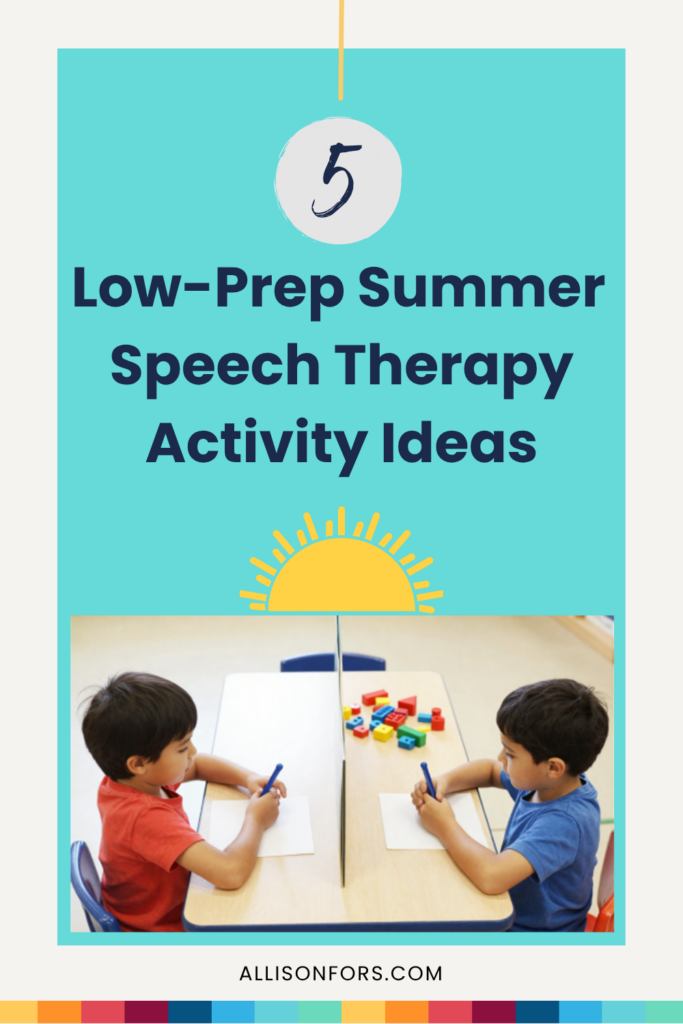
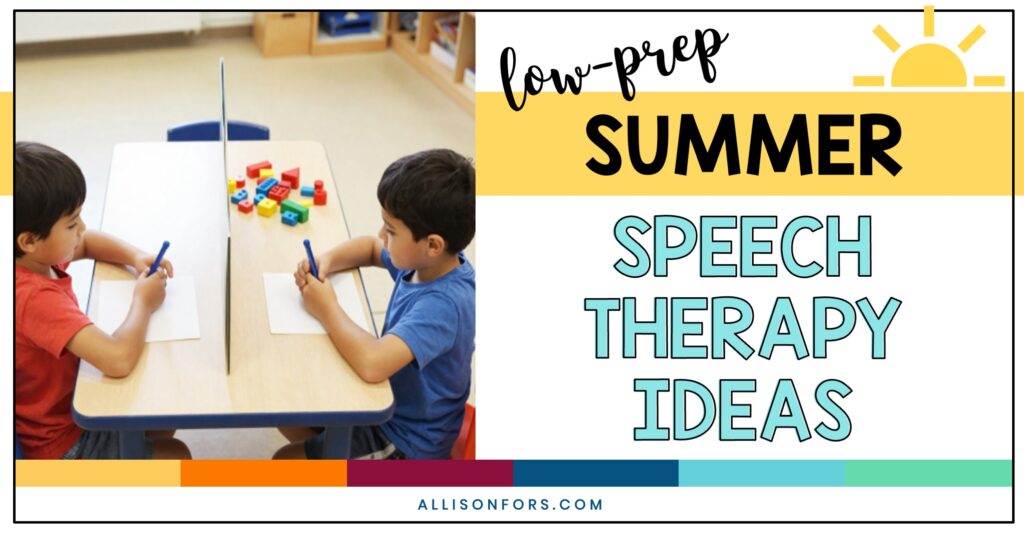
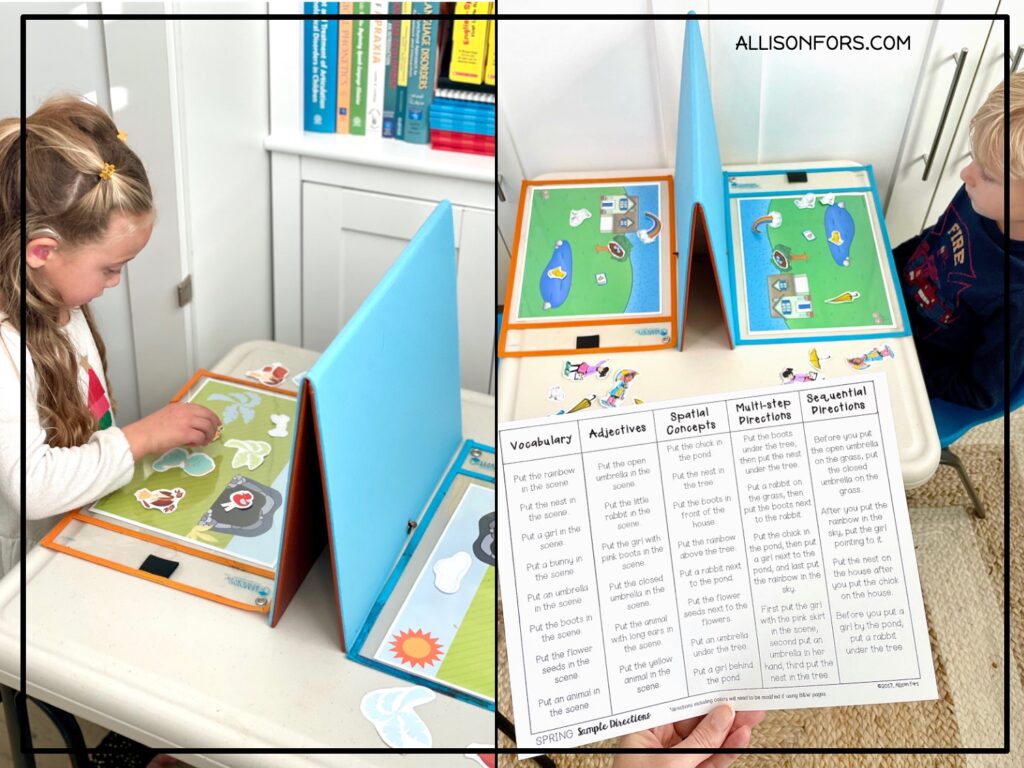
Two players, one barrier between them (a file folder works perfectly), each with a matching set of materials. One person describes; the other builds or arranges. Then you remove the barrier and compare.
What I love about barrier games is how much language they demand naturally. The student has to be specific, because “put the thing over there” doesn’t work when the other person can’t see what they’re doing. You’re targeting descriptive language, spatial concepts, following directions, and requesting clarification all at once, without it feeling like a drill. They work from preschool through upper elementary, and you can reuse the same materials for weeks.
You can apply the same concept of traditional barrier games to toys you make have in your speech room. You will just need to have two identical sets to make it work. Some ideas: Potato Head, legos/building blocks, sticker scenes, or coloring on a page.
Want to try out a free barrier game? Download the Caveman and Dinosaur Barrier Game with premade directions.
Are you new to barrier games? You can read more about what they are and discover all the ways to use them!
One person describes an image or scene; the other draws it without looking. Then you compare results.
This is a low-stakes activity with a built-in payoff, because kids genuinely love seeing how different the drawings turn out. The comparison at the end is actually where a lot of great language happens. “Wait, I said the dog was next to the tree, not under it.” That’s self-monitoring, revision, and descriptive language all in one moment. All you need is paper and something to describe. You probably have both within arm’s reach.
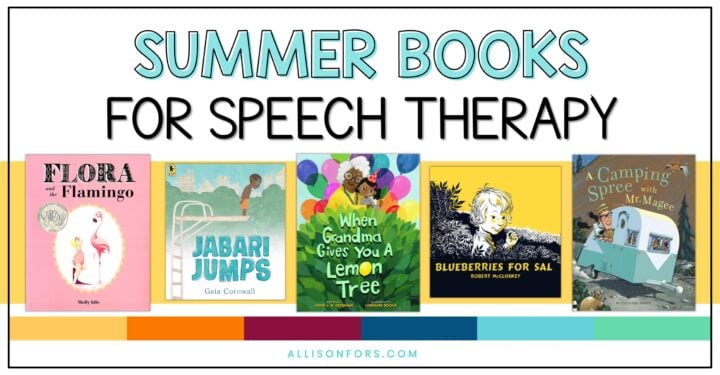
Read a short book or tell a quick story, then hand the student a few simple props (small toys, pictures, objects from your room) and ask them to tell it back to you. Want some fun summer-themed book ideas?
The props do something important here: they reduce the cognitive load of remembering what happened so the student can put more energy into actually constructing the language. You’ll often get more complete, more connected language with props than without them. This format targets narrative structure, sequencing, and referencing, and it works whether you’re targeting a one-event retell or a full story grammar sequence.

Show an image with something silly or impossible happening. Ask the student to describe what’s wrong and why.
This one targets inferencing, descriptive language, and cause-and-effect reasoning, and it’s highly engaging because there’s something inherently satisfying about spotting the absurd thing. You can find these visuals in picture books, on clip art sites, or you can skip the image entirely and just describe a ridiculous scenario out loud. “A dog is driving a school bus and all the kids are sitting in the back barking.” Go. The verbal-only version is especially useful when you’re between sessions and don’t have anything printed.
Give students a set of picture cards (animals, foods, objects, whatever you have on hand) and a loose task: “sort these however makes sense to you.” Then talk about the categories they made.
The “however makes sense to you” framing is deliberate. When there’s no right answer, there’s no anxiety about being wrong, and you often get more elaborate, more confident language as a result. You’re targeting vocabulary, categorization, and verbal reasoning, and the conversation that follows the sort is often where the richest language lives. Ask them to explain their categories. Push back gently. “I would have put these together, what do you think?”
None of these require specialized materials. None of them are target-specific, which means you can adapt them to whatever you’re working on that day. And none of them feel like worksheets, which matters more than we sometimes give it credit for.
Summer sessions, in particular, are a great time to lean into formats like these. The structure is looser. The kids are less burned out on sit-down work. And you have more room to follow their lead, which is where some of the best therapy happens anyway.
Pick one this week. Grab what you already have. That’s all it takes.
Thanks for reading!
What are your go-to, low-prep summer speech therapy activity ideas that you reach for?
You may also enjoy reading: