
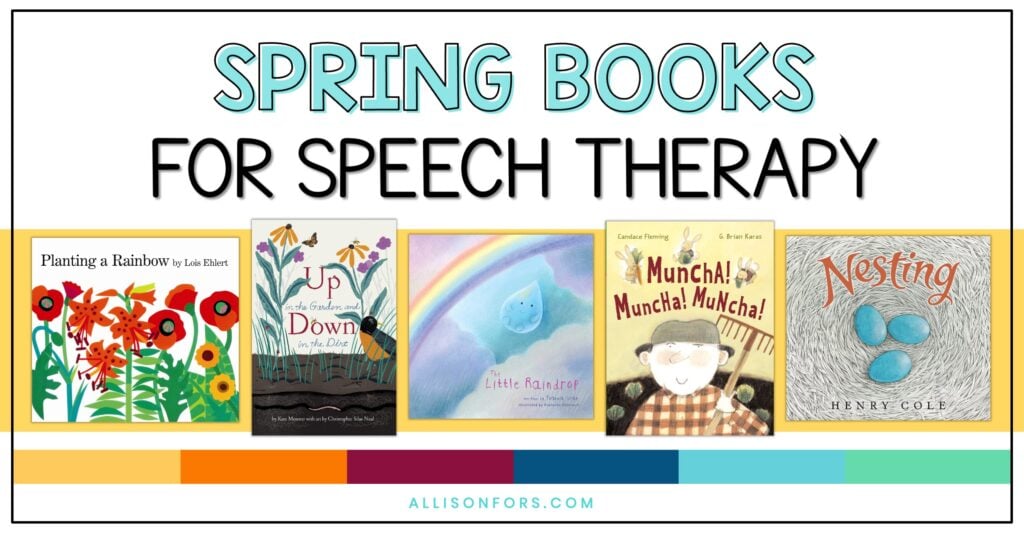
Looking for spring books to use in speech therapy or the classroom?
Books are great therapy tools. A well-chosen book can address articulation carryover, wh-questions, story grammar, vocabulary, and sequencing. Sometimes all in the same session and across a mixed group. The repeated exposure to language in context, the predictable structure, and the rich illustrations all create the kind of meaningful practice that sticks.
Here is a roundup of tried-and-true spring books for speech therapy, special education, and more. Included are some articulation and language targets you can address with the picture books.
The following spring-themed books are roughly organized from younger to older ages.
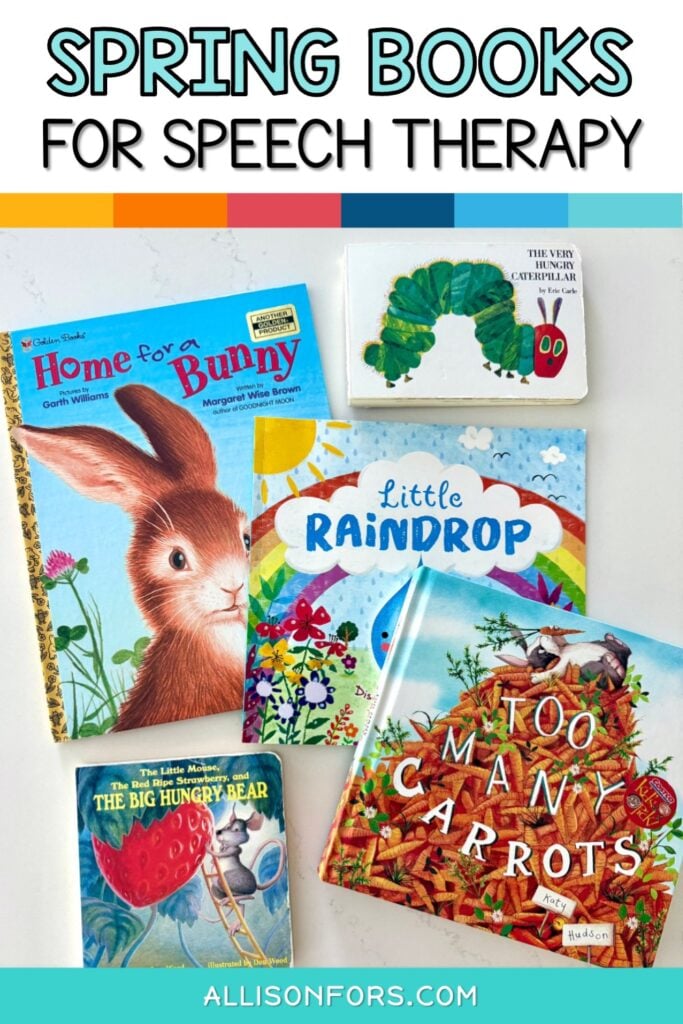
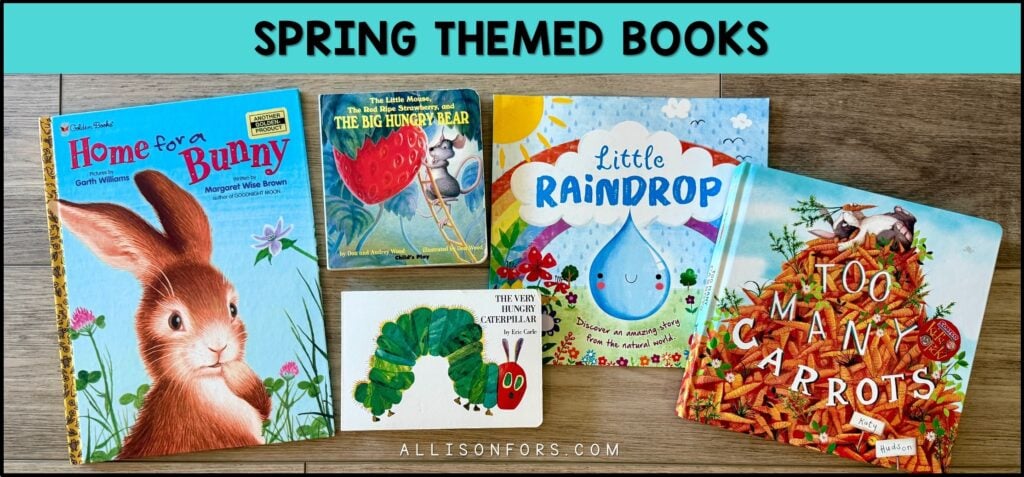
Home for a Bunny by Margaret Wise Brown
A bunny’s quest to find a home takes him through a series of animal encounters, which creates a natural scaffold for basic concepts, animal vocabulary, and simple wh-questions (Where does the robin live? Why can’t the bunny live there?). The repetitive question-and-answer pattern throughout makes it ideal for very young students or those just beginning to respond to wh-question prompts.
The Little Mouse, the Red Ripe Strawberry, and the Big Hungry Bear by Don and Audrey Wood
An interactive, suspenseful little book. The narrator speaks directly to the reader, and to the mouse, which tends to grab kids’ attention immediately. It’s excellent for basic concepts (whole, half, under, next to), spatial prepositions, and wh-questions at both literal and inferential levels. For articulation, /b/, /p/, /k/, and /g/ appear frequently across word positions. The short, punchy text and high-contrast illustrations make it accessible to a wide range of ages and abilities.
Planting a Rainbow by Lois Ehlert
The simple, predictable structure works well for younger students or those who need lower-demand, high-engagement materials. Bold, graphic illustrations and minimal text make this one a natural fit for describing and color identification. The adjective + noun combinations throughout (red tulips, purple pansies) give students concrete models for expanding noun phrases. It’s a go-to for early language goals such as categories, attributes, and basic wh-questions.
The Very Hungry Caterpillar by Eric Carle
The repetitive, predictable structure makes it ideal for sequencing, retelling, and temporal concepts like days of the week. For articulation, the text is loaded with /k/ (caterpillar, cake), /f/ (fruit, leaf), and s-blends, with opportunities to target multiple sounds across word positions. It also lends itself to wh-questions at every level (What did he eat on Monday? Why does his stomach hurt?), making it a versatile mixed-group book.
When Spring Comes by Kevin Henkes
Simple and lyrical, this book is great for preschool and early elementary students. The seasonal vocabulary is highly functional, and the descriptive language throughout lends itself to wh-questions about attributes and prediction (What do you think will happen when the snow melts?).
The Little Raindrop by Joanna Gray
The raindrop’s journey from cloud to puddle to river to ocean follows a clear sequential path, making it excellent for sequencing, retell, and introducing water cycle vocabulary. Spatial and positional concepts (down into the puddle, along the stream, out to the ocean) appear throughout. It’s a strong choice for clients who need sequencing support but respond better to narrative context than to isolated picture sequences.
A fantastic choice for sequencing and life-cycle vocabulary with early-elementary students. The seed’s journey through the seasons provides a clear, linear narrative structure that maps neatly onto story grammar elements. For articulation, the /s/ and /t/ sounds appear frequently in context, and the seasonal vocabulary gives students functional language to build on.
In the Tall, Tall Grass by Denise Fleming
Short, rhythmic, and packed with action words. The onomatopoeia and verb-heavy text make it excellent for vocabulary building and grammar targets like present progressive and irregular past tense. For articulation, the /l/, /g/, and /r/ sounds appear frequently in context. The simple narrative structure also supports early story retell for younger students.
There Was an Old Lady Who Swallowed a Frog by Lucille Colandro
The cumulative, predictable structure of this one does a lot of the heavy lifting. It’s excellent for sequencing, retell, and using temporal language (first, next, then, last). For articulation, velars (/k/, /g/), fricatives, glides, and a variety of consonant blends appear across the text. The repetition builds in multiple practice opportunities without feeling like drill work.
Muncha! Muncha! Muncha! by Candace Fleming
A great spring book for speech therapy to address problem-solving and predicting. Mr. McGreely builds increasingly elaborate barriers to keep bunnies out of his garden, which creates a built-in scaffold for cause-and-effect reasoning and character analysis. Students who are working on figurative language, adjectives, and irregular past tense verbs will find plenty to work with here. The repetitive structure also makes it approachable for students who need predictability to stay regulated and engaged.
Too Many Carrots by Katy Hudson
A funny, friendship-based story with a clear problem-solution narrative structure, which makes it ideal for story grammar work. Students can identify the characters, setting, problem, attempts, and resolution with minimal prompting. The repetitive pattern of the text also provides multiple exposures to the target vocabulary, and the /k/ and /r/ sounds appear throughout, facilitating articulation carryover during retell.
A boy gets his kite stuck in a tree and proceeds to throw increasingly absurd things up to knock it down. The escalating, predictable structure is excellent for predicting, sequencing, and absurdist humor, which makes it particularly useful for pragmatic language targets around shared reference and perspective-taking. Spatial prepositions appear naturally throughout (up in the tree, over the branch), and noun identification and describing are easy to layer in for mixed groups.
A nearly wordless book that follows a robin through the process of building a nest and raising her young. Because the text is minimal, it functions almost like a wordless picture book, which makes it exceptionally flexible for narrative elicitation at any level. Students generate the language rather than responding to it, which is ideal for assessing and building narrative skills. It’s also a natural fit for sequencing, describing, and basic cause-and-effect reasoning.
Up in the Garden, Down in the Dirt by Kate Messner
This one earns its place for older or higher-level students. The compare/contrast structure (what’s happening above ground versus below) creates a natural scaffold for describing, using context clues, and building Tier 2 vocabulary. It’s a strong choice for targeting past tense verbs and for practicing wh-questions that require inference rather than just literal recall.
Spring Stinks by Ryan T. Higgins
Bruce the bear does not want to wake up from hibernation, and his grumpy perspective makes for a great entry point into discussing character feelings and perspective-taking. This book is better for slightly older and works well for inferencing, identifying character emotions with text evidence, and higher-level wh-questions (Why does Bruce feel that way? What would you do?).
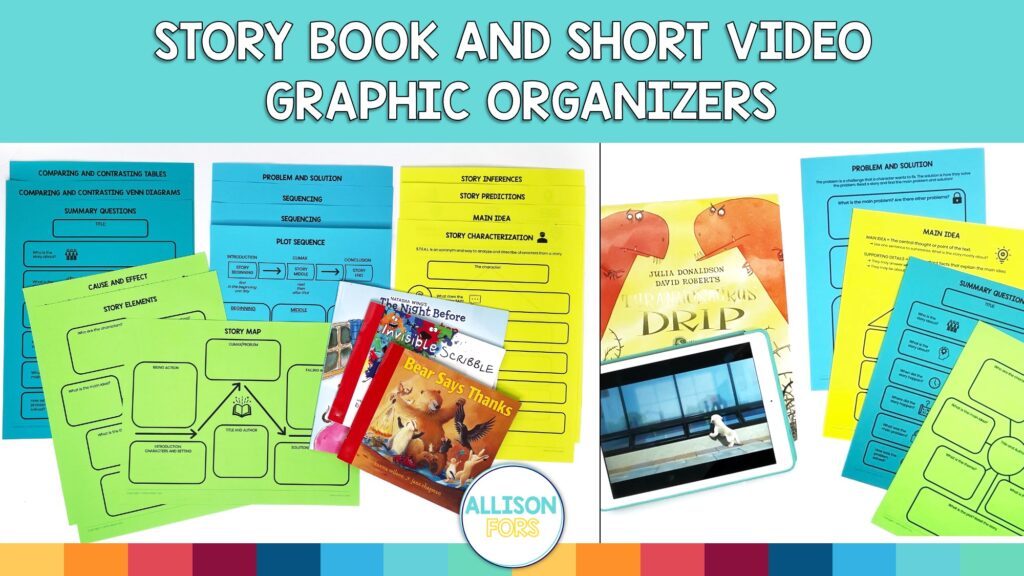
Need story elements graphic organizers to pair with your therapy books? This resource includes character traits, main idea, story retelling, sequencing, comparing and contrasting, and more. These versatile graphic organizer visuals support literacy skills, narrative comprehension, retelling, summarization, and generation.
Thanks for reading!
Do you have any other favorite spring books for speech therapy to add to this list?
You may also enjoy reading these book roundups:
13 Summer Books for Speech Therapy
30 Books to Target Inferencing
25 Wordless Picture Books

We are a participant in the Amazon Services LLC Associates Program, an affiliate advertising program designed to provide a means for sites to earn advertising fees by advertising and linking to Amazon.com. All opinions are my own.