Do you use books to target syntax? It can be difficult to come up with ideas to work on complex sentence structures with older students. In upper elementary and beyond, many students need explicit support with syntax, such as advanced conjunctions, passive voice, and relative clauses.
Books can be a great resource while incorporating syntax targets into speech therapy. Choosing vocabulary-rich, visually engaging, and story-driven books allows you to control the language level. Picture books provide a natural context for modeling, expanding, and practicing complex syntax in an engaging way.
More importantly, they create the perfect opportunity to use high-impact strategies like modeling, recasting, sentence combining, and sentence expansion.
How to Use Picture Books to Target Syntax
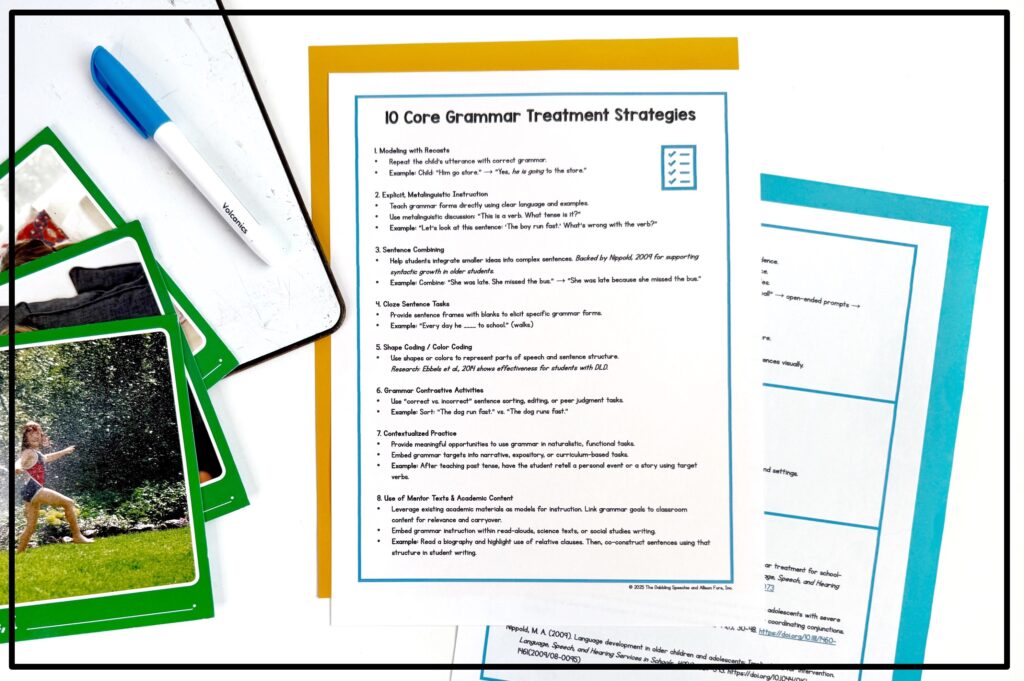
Before jumping into specific books, here are core strategies to implement:
Model: Give clear examples of the target structure
Recast: Repeat the student’s response with improved grammar or added complexity
Highlight Structures: Point out examples of the target within the text (relative clauses, passives, conjunctions, etc.)
Expand: Add details or clauses to simple sentences
Sentence Combining: Merge 2-3 simple sentences into one complex sentence
Visuals: Use sentence visuals, sentence frames, Shape Coding or color coding to support sentence building
This book has a girl who creates a world with a red crayon and goes on an adventure. This works great because the child must explain what’s happening, draw inferences, and reach conclusions while explaining themself.
Modeling: “She drew a boat, so she could go down the river.” And to use temporal conjunctions: “When she opened the door, she entered a new world.”
Recasting: “She drew a door.” → “She drew a door because she wanted to go somewhere.”
Highlight structures: Point out how conjucntions because, when, so would fit naturally in the story.
Expanding: Add clauses: “She drew a door” → “She drew a door because…”
Require structure: “Tell me what happened using ‘if’.”
A boy searches for his missing frog, leading to a series of humorous mishaps. Expand simple sentences into compound/complex sentences. This book has simple structure, but tons of opportunities for expansion.
Model (sequencing and contrast): “He looked in the jar, but the frog was gone.”
Expand with cause/effect: Why do you think he ran? → “He ran when he heard the noise.”
Sentence stems: Provide sentence stems for the student to complete. “The boy fell when…”
Sentence combining: Provide the student with two simple sentences that they must combine using a conjunction: “The boy looks surprised. The frog is gone.” → “The boy looks surprised because the frog is gone.”
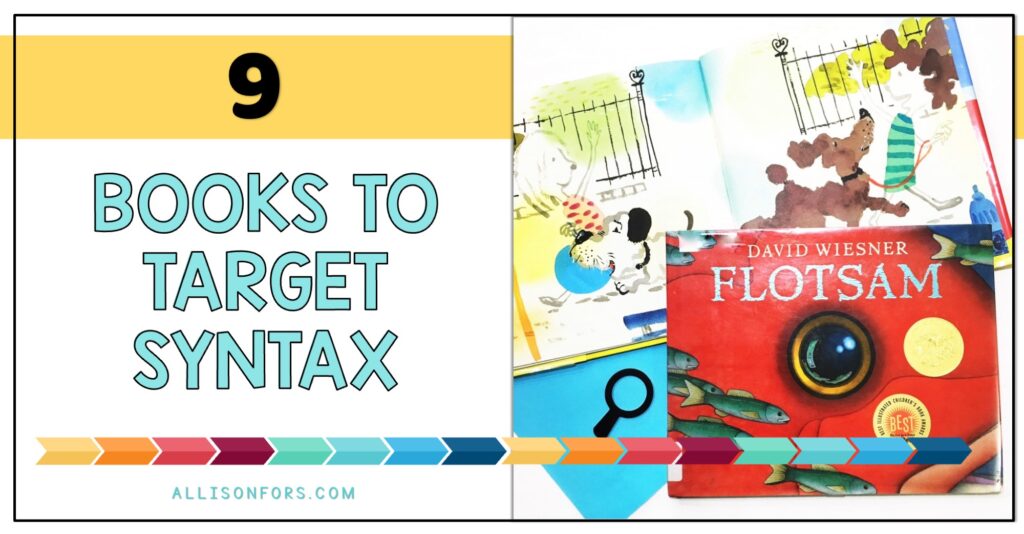
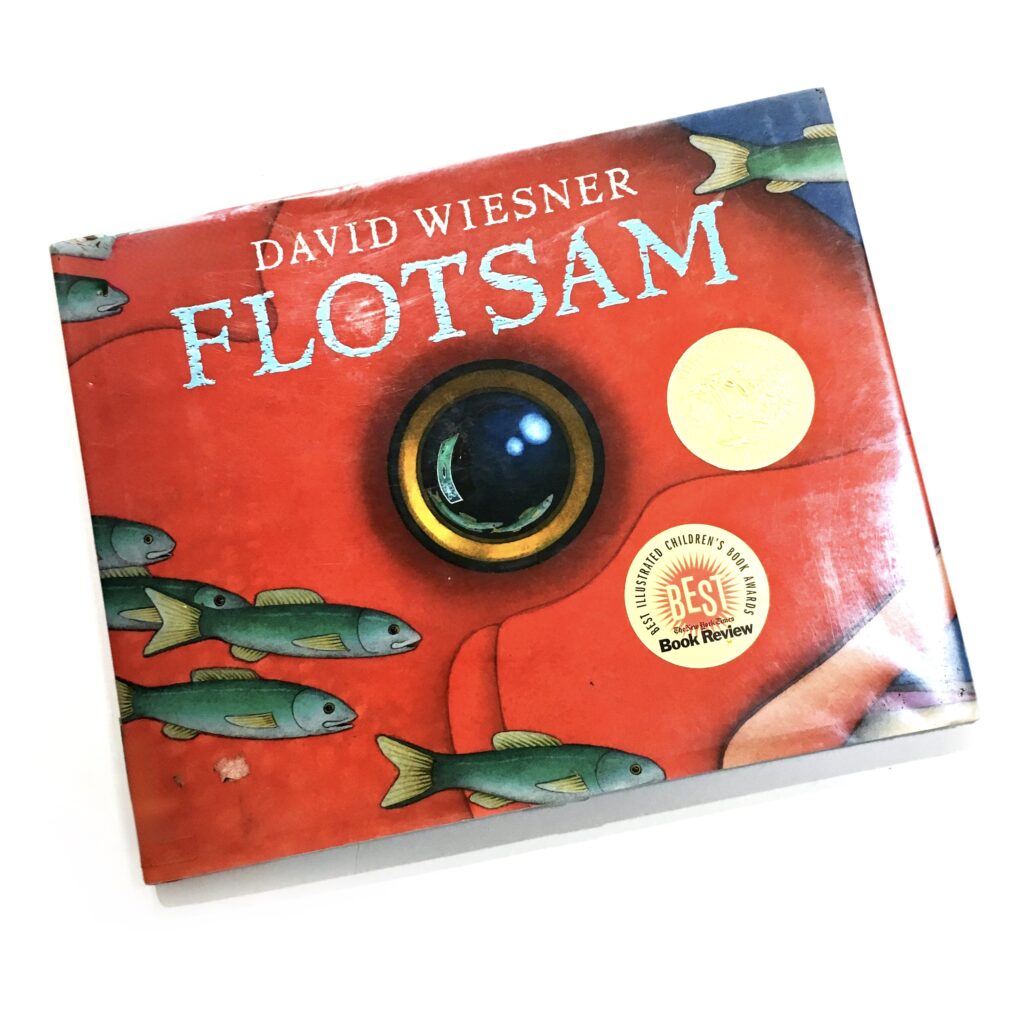
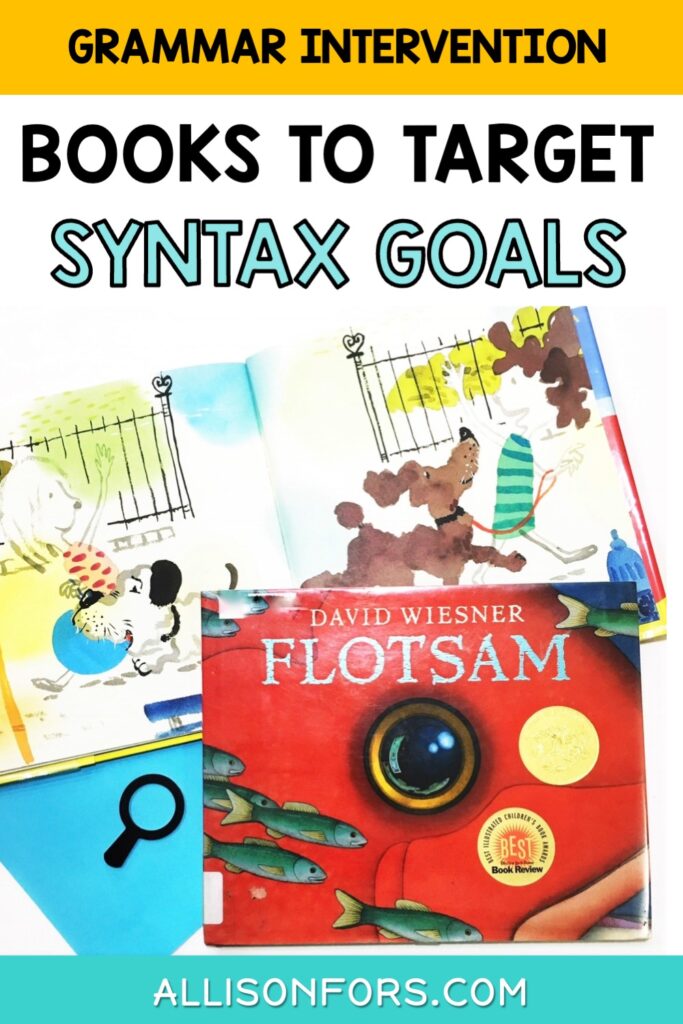
A boy discovers an underwater camera that reveals images of the ocean. This wordless picture book has many opportunities for inference: “He was surprised when he saw the pictures.” or “He kept looking because he was curious.”
Recasting for complexity: Add “when,” “after,” “so.” “He was surprised when he saw the pictures.
Sentence combining: Provide the student with two simple sentences that they must combine using a conjunction: “He found a camera. He was excited.” → “He was excited because he found a camera.”
Contrast: “The camera looked old, but it still worked.”
Books to Target Passive Voice
Passive voice can feel abstract when taught in isolation, but in books it comes up naturally, especially in nonfiction and cause/effect narratives.
A man falls asleep while trying to cut down a rainforest tree. Animals speak to him about why it should be saved.
Identify passive sentences: Identify passive forms within the text. “Moments before, the forest had been alive with the sounds of squawking birds and howling monkeys.”
Modeling: “The tree was cut by the man.”
Recasting: Student: “The man is cutting the tree.” → “The tree is being cut by the man.”
Contrast active vs passive: Active: “The man cut the tree.” Passive: “The tree was cut by the man.”
Sentence transformation: Provide an active sentence and have the student convert it into passive voice.
Sentence Combining: “The man cut the tree. The animals protested.” → “The tree was cut by the man while the animals protested.”
The history of a river from clean to polluted to restored. This book is perfect for cause/effect and environmental changes over time.
Identify passive sentences: “The river was polluted.”
Expanding: “The river was polluted.” → “The river was polluted by factories.”
Sentence combining: “Factories dumped waste. The river was polluted.” → “The river was polluted by factories dumping waste.”
Sentence transformation: Provide an active sentence and have the student convert it into passive voice.
Books to Target Relative Clauses
Relative clauses are often underdeveloped in older students. These books naturally push students to be more specific and descriptive.
Relative clauses help us add details about a person, place, or thing. They help the reader or listener understand which one we are talking about. They make sentences clearer and more interesting without adding extra sentences. They usually begin with who, what, that, which, where, when.
This is a great book to target syntax. It is a collection of illustrations with a single caption, encouraging storytelling and inference. It stimulates imagination and is open-ended, making it perfect for formulating different types of sentences.
Identify relative clauses: Identify relative clauses within the text. Discuss the additional information they add to the sentence.
Provide a relative pronoun: “Tell me about the boy…but you have to use ‘who.’”
Recasting and expanding: “The boy found a key.” → “The boy who found a key looks nervous.”
Sentence combining: Give two ideas and have students merge them: “The chair moved. It was in the room.” → “The chair that was in the room moved.”
Sentence stems: Provide sentence stems for the student to complete. “The kids who…”
This is an informational text with clear visuals and accessible explanations about sharks. Nonfiction books work well for reading and discussing information and details.
Identify relative clauses: Identify relative clauses within the text. Discuss the additional information they add to the sentence.
Model and expand facts: “This is a shark.” → “This is a shark that lives in the ocean.”
Provide a relative pronoun: “Tell me one thing about this animal using that.”
Sentence combining: “The shark is large. It has sharp teeth.” → “The shark that has sharp teeth is large.”
Sentence stems: Provide sentence stems for the student to complete. “The shark that…”
Frogs mysteriously fly through a quiet town late at night, creating a surreal and humorous sequence of events. There’s so much going on visually that you have to get specific, which naturally pushes students toward more complex sentences. Have students describe specific elements, and you can also prompt targeted descriptions.
Identify relative clauses: Identify relative clauses within the text. Discuss the additional information they add to the sentence.
Modeling: “I see a frog that is flying over the house.”
Recasting: Student: “The frog is flying.” → “Yes—the frog that is flying over the house looks surprised.”
Sentence stems: Expanding with provided relative pronouns. Complete the sentence: “The frog that…”
Sentence combining: “The frog is flying. It is over a house.” → “The frog that is flying is over the house.”
You turn any book into a powerful syntax intervention tool! I really recommend wordless books to target syntax. They often work best because they can be used with a wide-age range and force students to generate their own sentences.
Thanks for reading. Leave a comment below with more ideas on books to target syntax in speech therapy!
If you enjoyed this post, please share it!
We are a participant in the Amazon Services LLC Associates Program, an affiliate advertising program designed to provide a means for sites to earn advertising fees by advertising and linking to Amazon.com. All opinions are my own.