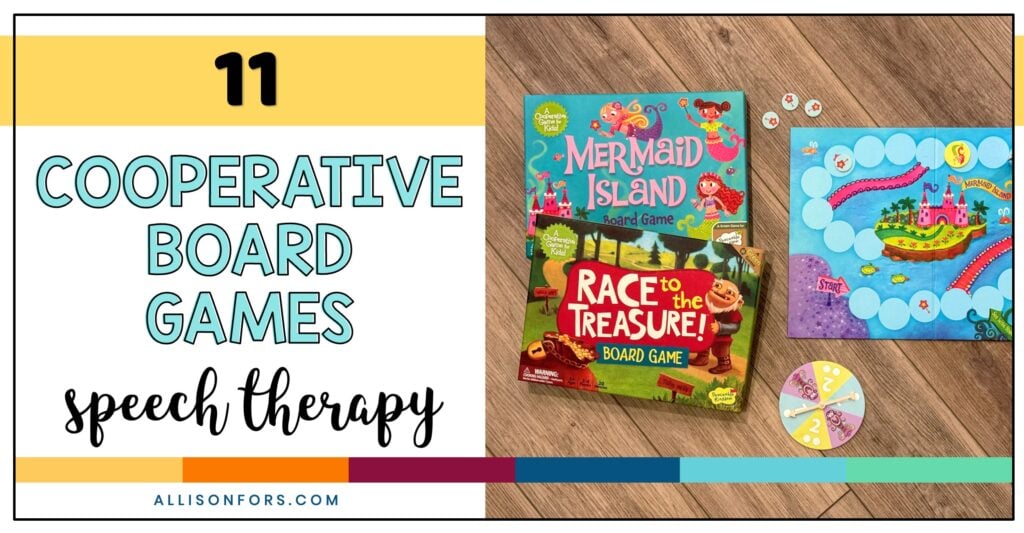
Board games are a staple in most speech rooms. They’re motivating, familiar, and easy to pull off the shelf and use for many speech and language goals. I specifially really love cooperative board games because they work great with mixed groups, social skills groups, reluctant talkers, and any session where I want language to happen naturally instead of on cue.
Cooperative board games give you the motivation of a game with far more natural communication than most competitive options. They move quickly, keep everyone involved, and turn every turn into a conversation. Whether you’re working with preschoolers on early vocabulary or teens on semantic relationships, there’s a cooperative game that fits.
In a cooperative board game, everyone plays on the same team against the game itself. You beat the Ogre, outrun the Sea Witch, or get the owls home before sunrise together. Or you don’t, and you all try again. Most cooperative games for kids are also built to move quickly. Turns are short, setup is simple, and many games wrap up in 10 to 15 minutes. That pace matters in therapy. Quicker turns mean less waiting, more trials, and plenty of natural breaks to drop in articulation practice or a language target before each spin or card. You can often finish a full game (or two) and still have time to wrap up the session.
The bigger win is the talking. Because the whole group shares one goal, every move becomes a group decision. Which owl should we move? Do we block the path or grab the key? Is it this fox or that one? Students have to suggest, ask, agree, disagree, explain their reasoning, and listen to someone else’s idea. That’s a lot of authentic dialogue packed into one game, and it gives you room to target requesting, commenting, asking questions, using “because,” perspective taking, and conversational turn-taking without it ever feeling like a drill. The stakes feel lower, too. When the game is the bad guy, nobody has to be the loser, which keeps the focus on communication instead of competition.
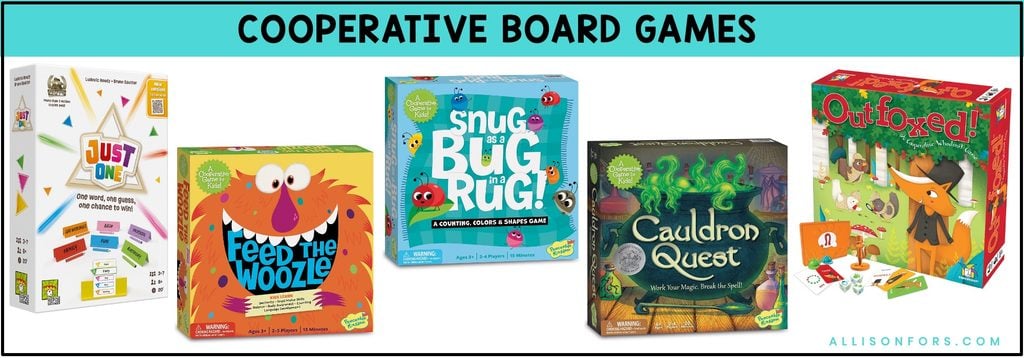
1. Feed the Woozle (Ages 3+) Players work together to feed the hungry Woozle silly snacks by walking them across the room on a spoon. It’s active, goofy, and perfect for little ones who struggle to sit still. Use it for food vocabulary, describing words, following directions, and early commenting like “yummy,” “yucky,” and “uh oh!”
2. Snug as a Bug in a Rug (Ages 3+) Players spin to find bugs by color, shape, or number of eyes and tuck them under the rug before the stink bugs show up. With multiple levels of play, it grows with your students. It’s a great fit for colors, shapes, counting, describing attributes, and categorizing.
3. Count Your Chickens (Ages 3+) Spin, count, and help the baby chicks get back to the coop before the fox arrives. Turns are fast, making this ideal for high-trial articulation practice. It also works well for counting, animal names, and core words like “go,” “more,” and “help.”
4. Hoot Owl Hoot! (Ages 4+) Players draw color cards to fly the owls back to their nest before the sun comes up. Since any player can move any owl, there’s a decision to talk through on every turn. Target colors, “which one?” questions, and simple reasoning about which owl to move and why.
5. Dinosaur Escape (Ages 4+) Help three dinosaurs reach the safety of the ship before the volcano erupts. The memory element keeps everyone engaged, even when it’s not their turn. Use it for dinosaur vocabulary, “where” questions, recall, and making predictions.
6. Race to the Treasure! (Ages 5+) Players build a path together, collect the keys, and race to beat the Ogre to the treasure. Every tile placement is a group decision, making this a natural fit for problem-solving language. It’s also great for spatial concepts like up, down, next to, and across.
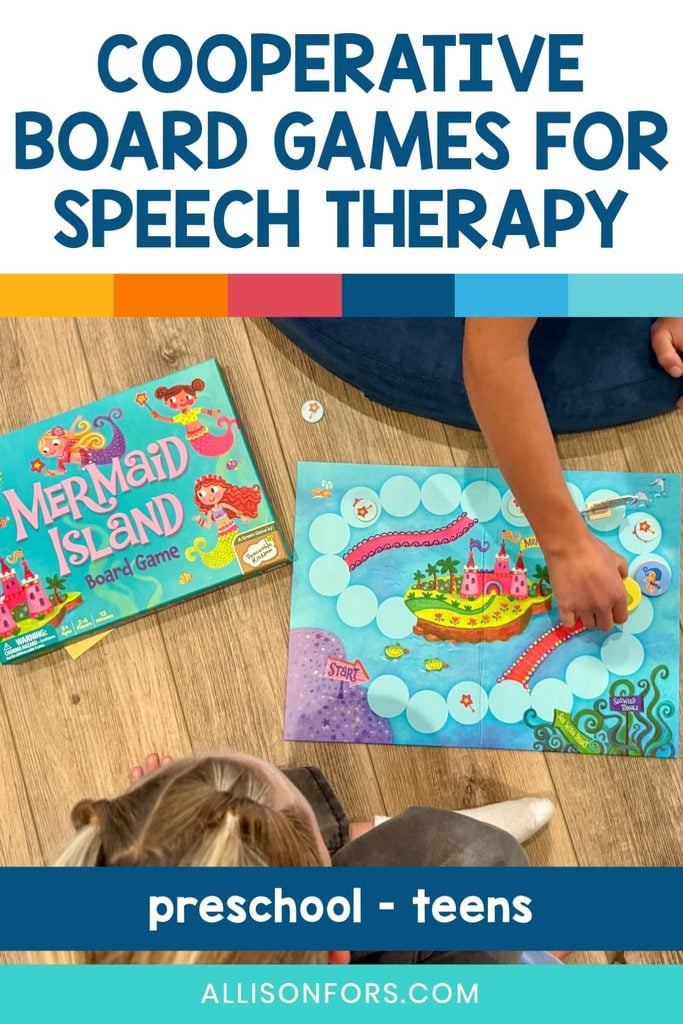
7. Mermaid Island (Ages 5+) Work together to help the mermaids swim to Mermaid Island before the Sea Witch gets there. Players can move any mermaid, so the group has to agree on the best move. Target sequencing words, strategy talk, and “first, next, last” retells after the game.
8. Outfoxed! (Ages 5+) A fox has stolen Mrs. Plumpert’s prized pot pie, and players gather clues to figure out which fox did it before the thief escapes. Students describe clothing and accessories, use negatives (“It’s not him. He isn’t wearing glasses.”), make inferences, and justify their thinking with “because.”
9. Cauldron Quest (Ages 6+) Players work to get the three correct ingredients into the cauldron before the evil wizard blocks all six paths. It’s a step up in strategy, which makes it great for planning language, “if/then” statements, and deductive reasoning.
10. Just One (Ages 8+) One player guesses a mystery word while everyone else writes a one-word clue. The catch? Any matching clues get canceled, so players have to think beyond the obvious. It’s fantastic for semantic associations, synonyms, Tier 2 vocabulary, and word retrieval. It plays best with three or more people, so jump in yourself with smaller groups. Looking for a higher-level tier 2 vocabulary resource?
11. Forbidden Island (Ages 10+) Players each take on a special role and work together to collect four treasures before the island sinks. It takes a session to learn, but once your students know it, the planning conversations are rich. Use it to explain reasoning, negotiate, take perspectives, and repair conversations when the team disagrees.
The Play-Based Therapy Handouts Guidebook has a section on games:
This well-rounded guidebook explains what child-led therapy looks like and the research behind play-based learning. It provides countless tips and activity ideas for toys, games, books, and themes with specific speech and language targets. Use pages as parent handouts to explain what play-based therapy is and why it’s beneficial, the development of play skills, tips for choosing toys, book and game ideas, how to use everyday objects as tools, and more.

Thanks for reading!
Do you have any favorite cooperative board games? Let me know!
We are a participant in the Amazon Services LLC Associates Program, an affiliate advertising program designed to provide a means for sites to earn advertising fees by advertising and linking to Amazon.com. All opinions are my own.