
How hearing loss affects speech development. This post outlines what speech therapists should know when working with deaf and hard of hearing children.
My daughter got bilateral hearing aids at 4 years old, right before she started public school. Since then, I’ve learned so much about hearing devices, FM systems, and accommodations from her audiologist, her IEP team, and plenty of real-life experience.
Many of us got a lecture or two on hearing loss, but then a student with hearing aids or a cochlear implant shows up on our caseload, and we’re expected to know exactly what to do.
This post walks through what SLPs should know about speech therapy for hearing loss: how it can affect speech sounds, grammar, vocabulary, and listening, and what to keep an eye on.
Hearing loss looks different in every child. The impact depends on the degree and type of loss, when it was identified, how consistently the child has had access to language, and their individual needs. Treat the areas below as things to monitor, not deficits you should expect to find.
It also helps to remember that a child’s performance doesn’t always show the effort behind it. A student who seems to be keeping up may be working much harder than their peers just to access spoken information. Listening conditions, auditory access, and listening fatigue all belong in the picture.
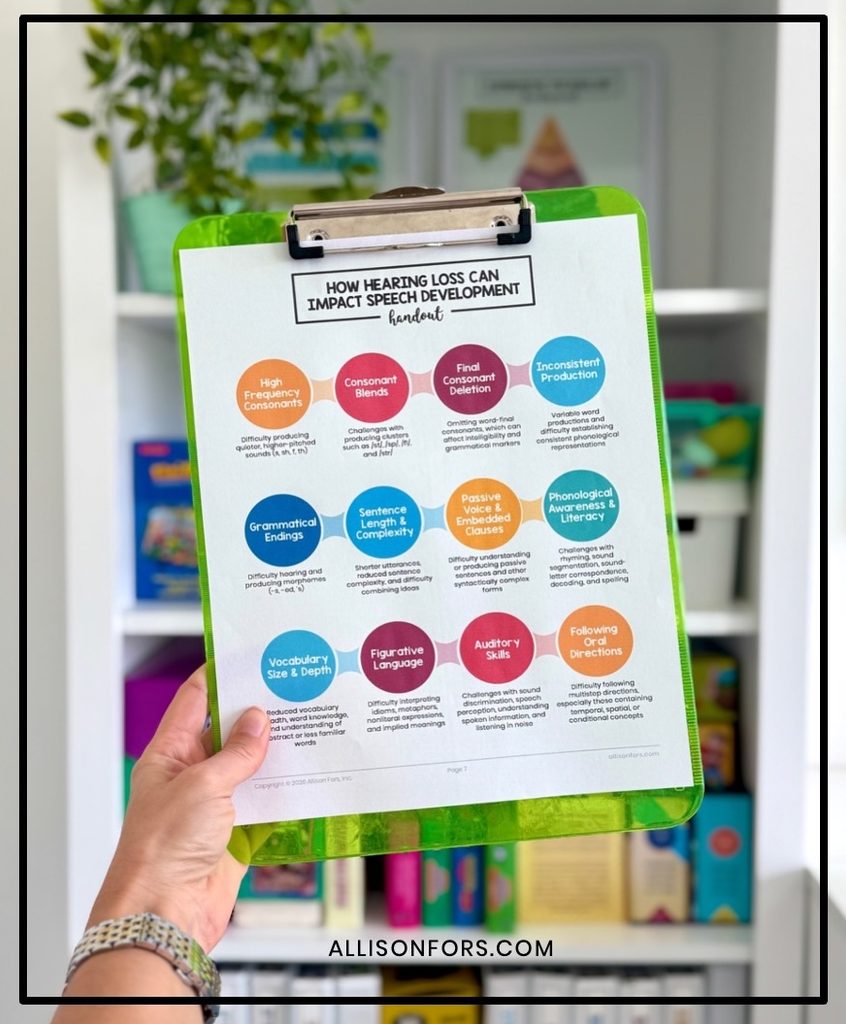
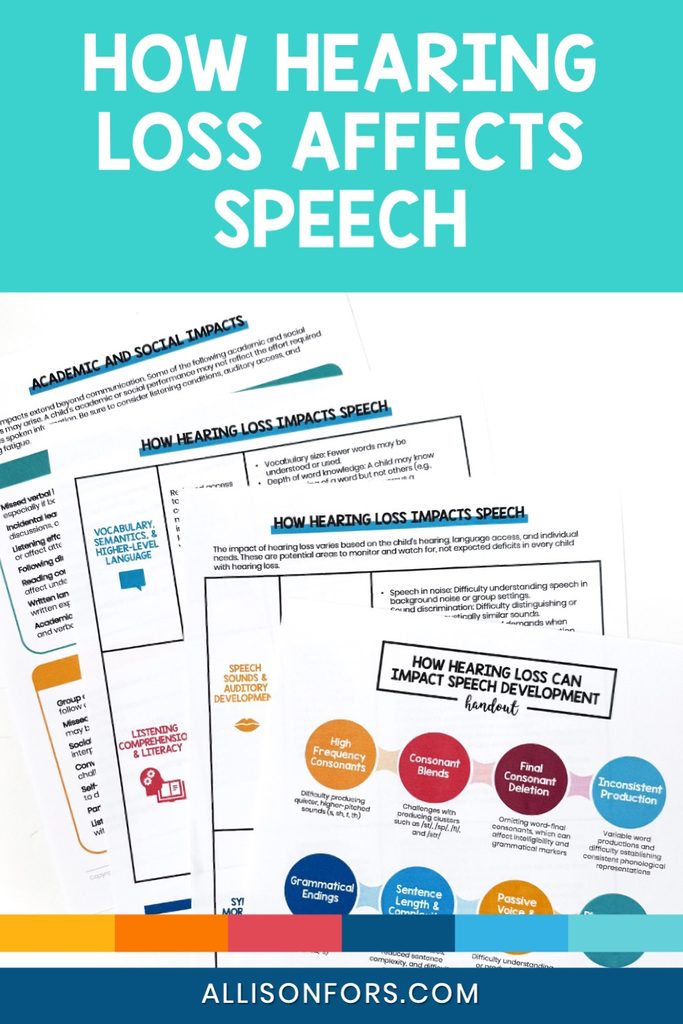
Not all speech sounds are equally easy to hear. High-frequency, low-intensity consonants like /s/, /z/, /f/, and /θ/ (“th”) are some of the hardest to catch, and a sound a child can’t hear reliably is hard to learn to produce. Watch for:
Consonant blends like /st/, /sp/, /fl/, and /str/, which are harder both to hear and to produce
Final consonant deletion, which reduces intelligibility and can take grammatical markers with it
Inconsistent production across words or contexts
Difficulty with sound discrimination, especially between acoustically similar sounds
Resonance and voice differences. Limited auditory feedback makes self-monitoring harder, which can show up in resonance (including hypernasality), pitch, loudness, vocal quality, and intonation.
Many grammatical markers are acoustically tiny. Plural -s, past tense -ed, third-person -s, and possessive -‘s are easy to miss, and so are short function words like is, are, the, and a. Children may omit or misuse them.
Sentence structure matters too. Shorter, simpler sentences may persist longer, and noncanonical structures can be harder to understand. Think embedded clauses (“The dog that chased the cat ran away”) and passive voice (“The ball was thrown by the boy”). Fast conversational speech makes all of this harder to catch.
Much of vocabulary is picked up incidentally, from overheard conversations, side comments, and background talk. When access to that is reduced, both the size and the depth of a child’s vocabulary can be affected. A student might know bank as a place for money but not the side of a river.
Abstract and figurative language, inferencing, and narrative skills are also worth monitoring. Idioms, implied meaning, and organizing a story with clear sequence and relevant details all build on that broad language foundation.
In the classroom, the demands stack up quickly. Multistep oral directions, unfamiliar vocabulary or temporal terms, and information that’s said only once all tax auditory memory. Add background noise, distance from the teacher, or competing voices, and important information can simply be lost.
Phonological awareness deserves attention too. Rhyming, sound identification, segmenting, and blending can be affected, and those skills feed directly into decoding, spelling, reading comprehension, and writing.
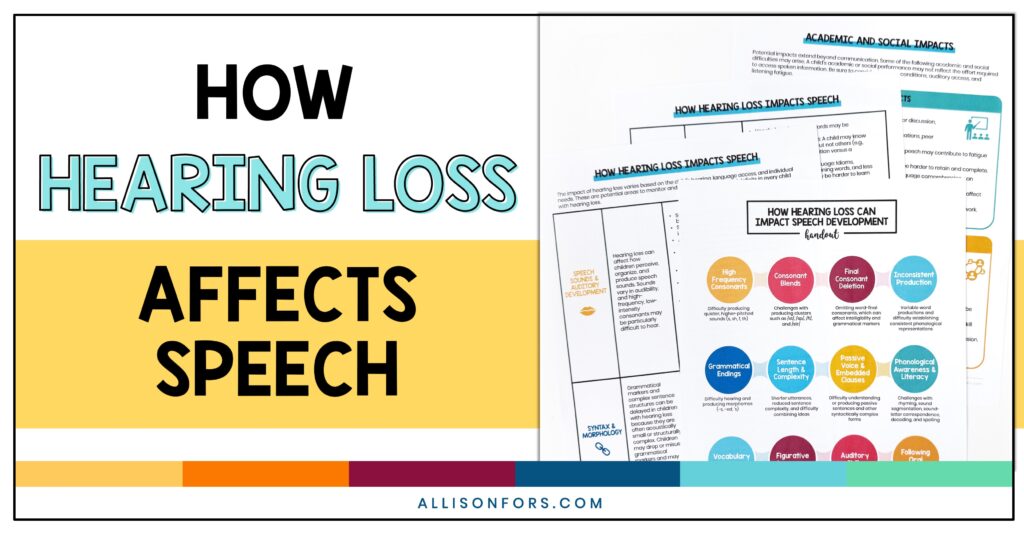
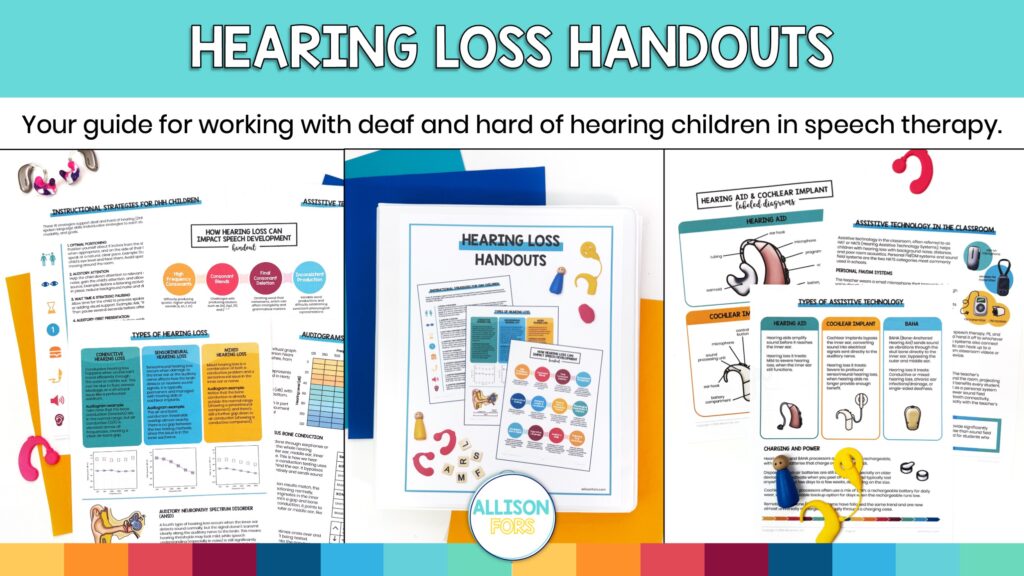
The Hearing Loss Handouts will help you feel confident supporting deaf and hard of hearing students in speech therapy. This guidebook gives SLPs and SLPAs concise, easy-to-understand information on hearing loss, plus strategies you can use in your sessions right away.
This guidebook is a collection of 33 handouts and information pages for speech therapists working with deaf and hard of hearing students.
You may also be interested in reading: