
Have you heard of the auditory hierarchy or listening hierarchy? When a child gains access to sound through hearing aids or a cochlear implant, the brain must learn how to interpret these sounds. That process develops step by step through what’s known as the auditory hierarchy. Understanding this hierarchy helps SLPs, educators, and families support children who are deaf or hard of hearing as they build meaningful listening and spoken language skills.
The auditory hierarchy describes the developmental sequence of listening skills. This is how a person moves from simply detecting sound to understanding spoken language.
This concept is widely used in auditory-verbal therapy, auditory training, and early intervention for children who are deaf or hard of hearing. It helps SLPs and teachers target listening skills in a structured way. Particularly for children using hearing aids or cochlear implants.
One of the biggest misconceptions is that once a child can “hear,” they can automatically understand speech. But hearing and understanding are not the same.
A child with hearing technology may have access to sound, but they still require time and practice to develop the brain pathways necessary for auditory comprehension. As Carol Flexer, Ph.D., CCC-A, said,
“Hearing happens in the brain, not the ears.”
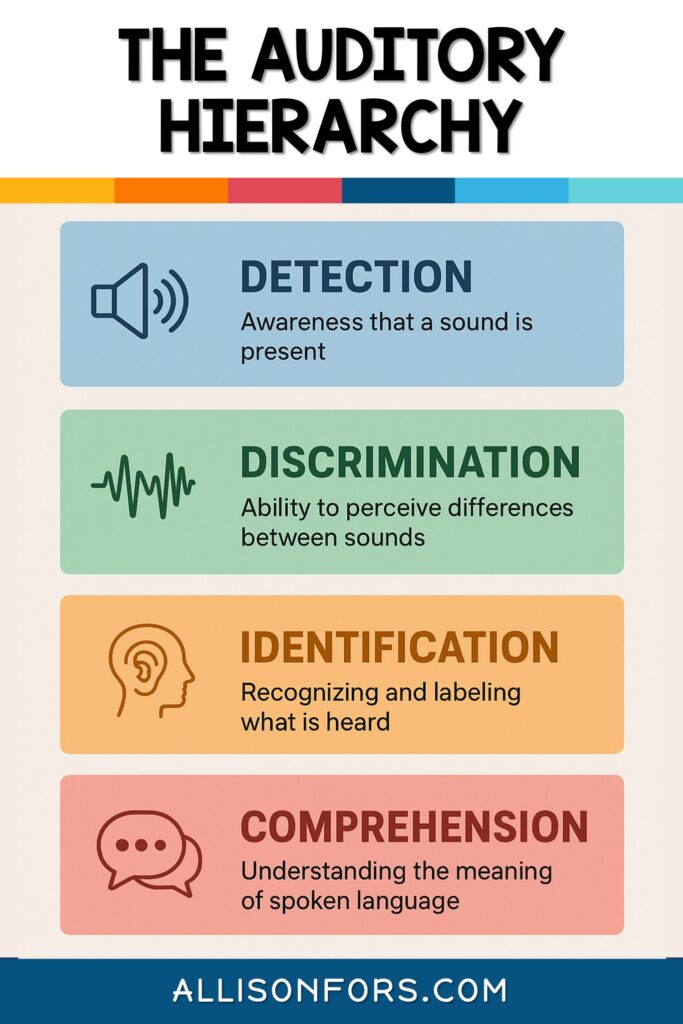
The auditory hierarchy describes the developmental sequence of listening skills – from detecting sound to understanding spoken language. (Erber, 1982; Lalonde & Holt, 2016).
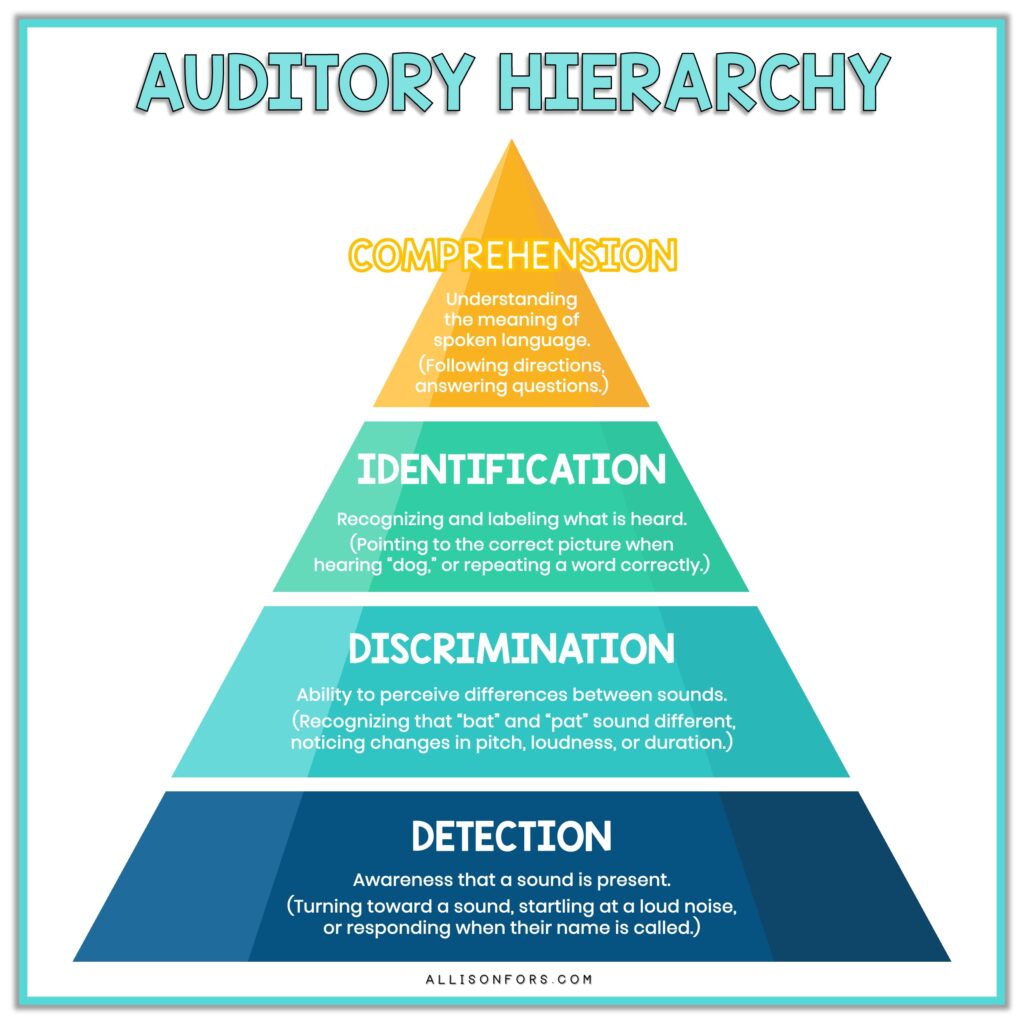
Download this free infographic.
The ability to notice or respond when a sound is present. For example, when a baby startles at a loud noise, a toddler turns when called by name, or a child with a new cochlear implant reacts when a sound processor is activated. Establish consistent auditory awareness across a range of sounds (speech, environmental, and non-speech).
Recognizing that two sounds or words are different. For example, distinguishing between /m/ and /s/, or noticing the difference between “up” and “cup”, or identifying a question versus a statement by intonation. Discrimination skills are essential for developing accurate speech perception and phonological awareness, which supports later reading development.
Associating a sound or word with its meaning and responding purposefully. For example, pointing to “dog” when hearing the word, choosing the correct toy when told “get the ball”, or repeating a word correctly after hearing it. Identification often relies on closed-set tasks (e.g., choosing between a few known options) before moving to open-set listening (understanding in conversation).
The ability to interpret and respond appropriately to spoken language in context. For example, following directions like “Go get your shoes and put them by the door.”, answering questions about a story, or engaging in conversation without visual cues. This is the ultimate goal of auditory learning. We want to understand spoken language without relying solely on visual information.
The auditory hierarchy provides a roadmap, illustrating how children who are deaf or hard of hearing progress from noticing sound to fully understanding and using spoken language. By focusing therapy and family support at the appropriate level, we can help children make progress.
Early identification, consistent use of hearing technology, and rich auditory experiences make all the difference. With the right support, every child can establish a strong foundation for lifelong listening, learning, and communication.
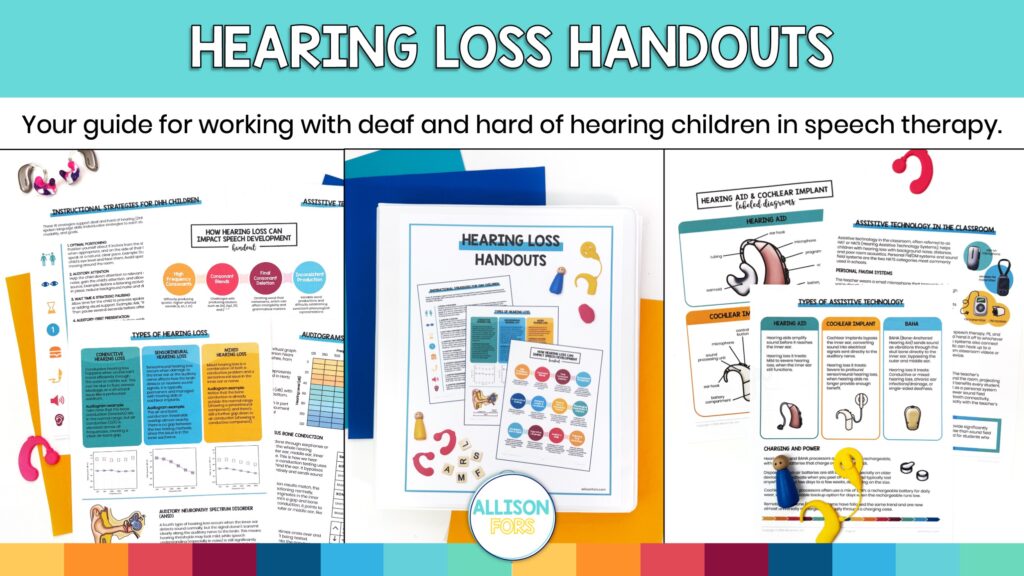
The Hearing Loss Handouts will help you feel confident supporting deaf and hard of hearing students in speech therapy. This guidebook gives SLPs and SLPAs concise, easy-to-understand information on hearing loss, plus strategies you can use in your sessions right away.
You may also be interested in reading:
If you enjoyed this post, please share it!
One Response
Alison,
Do you have any of these materials in Spanish??
Kathi Riley