
Learn practical, evidence-based tips for treating cleft palate speech in children. Explore strategies for articulation, placement, and tactile cues to improve oral airflow, resonance, and intelligibility in speech therapy.
Treating cleft palate speech requires a different approach and lens compared to traditional articulation or phonology delays. Children with cleft palate often develop unique error patterns due to differences in oral structure and airflow, so traditional articulation therapy alone isn’t always effective.
Instead, therapy should focus on establishing correct oral placement, eliminating compensatory errors, and improving overall intelligibility.
Begin by carefully selecting target sounds based on the child’s stimulability and which errors most impact intelligibility. For example, a child who can approximate /p/ with light nasal emission may make faster progress than one who cannot produce any oral pressure sounds.
It’s also important not to overlook phonological errors, such as final consonant deletion or cluster reduction. These may contribute more to reduced clarity than isolated articulation errors. Children affected by a cleft palate have been described as having articulatory deficits with associated phonological consequences (Harding & Grunwell, 1995).
Choose your treatment approach, whether phonological or articulation-based, according to the number and types of errors present.
Start with voiceless cognates (e.g., /p/, /t/, /k/) before moving to their voiced counterparts, as these are typically easier to produce with adequate intraoral pressure. If a child is using compensatory articulation patterns for most pressure sounds, select simple target words that contain only one high-pressure phoneme to minimize frustration and increase success.
Establish a strong foundation before moving through the treatment hierarchy. Make sure the child can produce the target sound in isolation with consistent accuracy (close to 100%) before advancing to syllables or words. Incorporate auditory and visual discrimination activities so the child learns to recognize when a sound is produced correctly or incorrectly. Sometimes, renaming sounds (such as /s/ the “snake sound” or /p/ the “pop sound”) can help build new motor pathways and separate correct production from previous error patterns.
Placement cues are essential for establishing accurate articulatory movements. Use phonetic placement techniques, often starting with bilabials (e.g., /p/, /b/, /m/) and then progressing to alveolars (e.g., /t/, /d/, /n/). Focus on correct placement before modifying manner or voicing, and only adjust one feature at a time to reduce confusion.
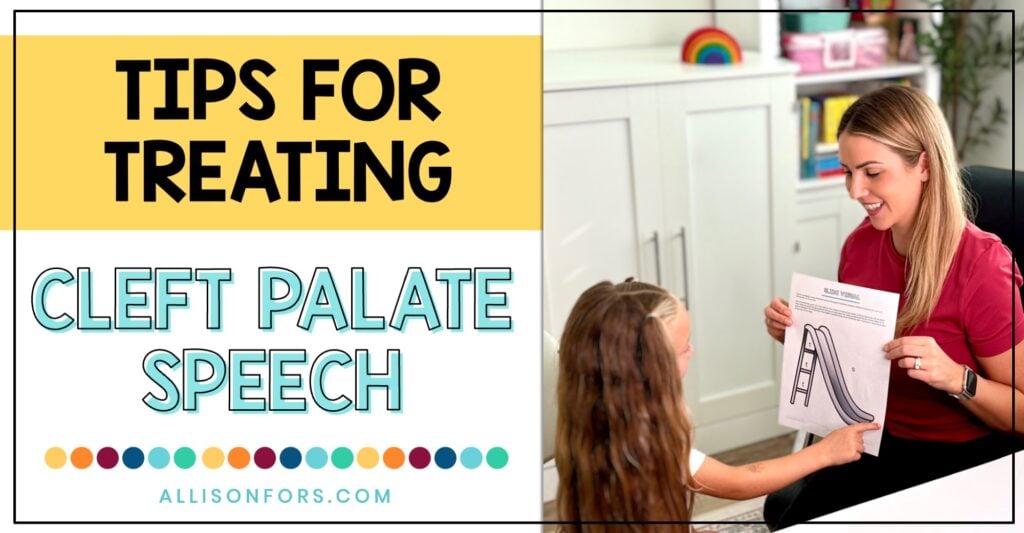
For example, you can redirect airflow anteriorly to turn a /t/ sound into an /s/ sound! Use the slide visual with a favorite toy, such as a car, doll, or mini object, to climb the ladder while producing a /t/ on each step. Hold the exact tongue placement as you go down the slide, producing the /s/. Ensure there is no pause between the /t/ and /s/. If the child is substituting nasal fricatives, you may use a nasal occlusion at the top of the slide.

Tactile cues can provide powerful sensory feedback during therapy. Have the child touch their neck to feel for inappropriate glottal activity, or place a finger beside the nose to detect nasal vibration during fricatives. Feeling a puff of air on the hand during plosives or using gentle nasal occlusion can increase awareness of oral airflow and pressure. These cues help reinforce the difference between oral and nasal resonance and promote correct sound production.
Use a lateral diagram for a visual to illustrate when the child is producing a “mouth sound” or a “throat sound” while remediating stop and pharyngeal compensatory articulation errors. You can also use a visual to illustrate when the child is producing oral airflow “mouth sound” versus nasal airflow “nose sound” while remediating nasal fricatives or developing an awareness of hypernasal resonance.
It’s important to note that non-speech oral motor exercises (things like blowing bubbles or horns, whistling, or lip stretching) are not effective for treating speech sound errors, even in children with cleft palate.
Through consistent practice, multisensory feedback, and well-chosen targets, children with cleft palate speech can make meaningful gains in their articulation and overall communication confidence.
Consistency and intensity are key. Schedule high-frequency sessions and aim for many repetitions per session. Be sure to establish a home practice program so the child can carry over new sounds into everyday communication.
If progress stalls over four or five sessions, this might signal the need for a new approach or target. If you suspect velopharyngeal insufficiency, refer the child to a craniofacial team.
The Cleft Palate Speech Guidebook is a comprehensive manual for evaluating and treating cleft speech. This unique cleft speech book has concise, easy-to-understand information for SLPs and SLPAs to assess cleft speech. In addition, how to treat articulation and compensatory errors. It contains over 100 pages of accessible information to feel confident in treating cleft speech!

You may also be interested in reading:
Cleft Lip and Palate Topic Page

If you enjoyed this post, please share it!