
Looking for autumn or fall books to use in speech therapy or the classroom?
Books are great therapy tools. A well-chosen book can address articulation carryover, wh-questions, story grammar, vocabulary, and sequencing. Sometimes all in the same session and across a mixed group. The repeated exposure to language in context, the predictable structure, and the rich illustrations all create the kind of meaningful practice that sticks.
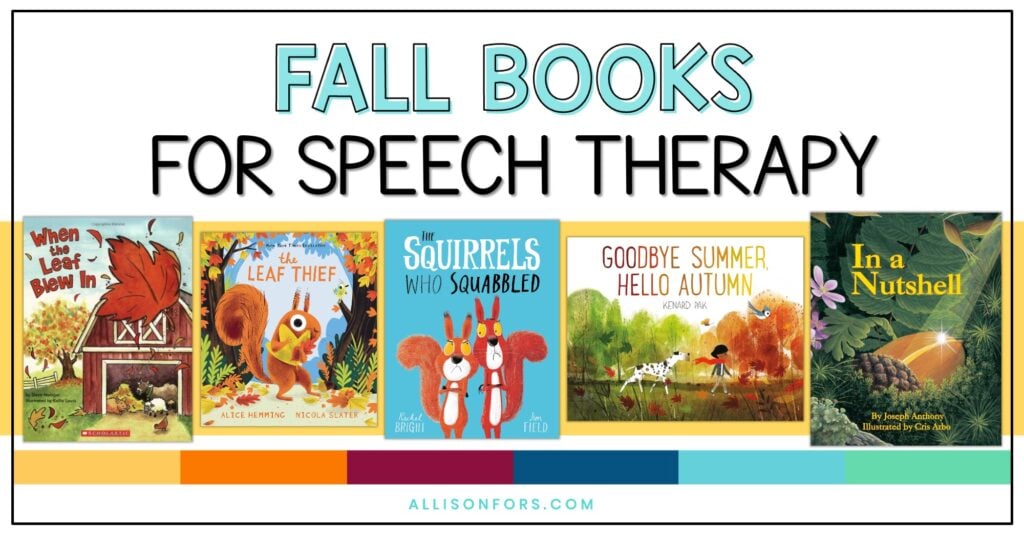
Here is a roundup of tried-and-true fall books for speech therapy, special education, and more. Included are some articulation and language targets you can address with the picture books.
Fall books worth reaching for…The following fall-themed books are roughly organized from younger to older ages.
Pete the Cat: Falling for Autumn by James and Kimberly Dean
The familiar Pete the Cat format makes this one immediately accessible for younger or lower-level students who already know the character. It’s a natural fit for basic concepts, seasonal vocabulary, and simple wh-questions, and the theme of adjusting to change opens the door to social-emotional targets around transitions and flexible thinking. For articulation, /p/, velars, and /f/ appear consistently throughout. This is a low-demand, high-engagement session starter for the youngest caseloads!
When the Leaf Blew In by Steve Metzger
A single leaf blows into a barn and sets off a chain reaction of chaos among the farm animals. The repetitive, cumulative structure gives younger students multiple exposures to the same sentence patterns, animal vocabulary, and cause-and-effect language. Animal sounds, action verbs, and sequencing targets are built right into the text, which makes it easy to use with early language students and mixed groups. For articulation, the repeated /l/ in leaf and the animal names throughout provide natural drill opportunities.
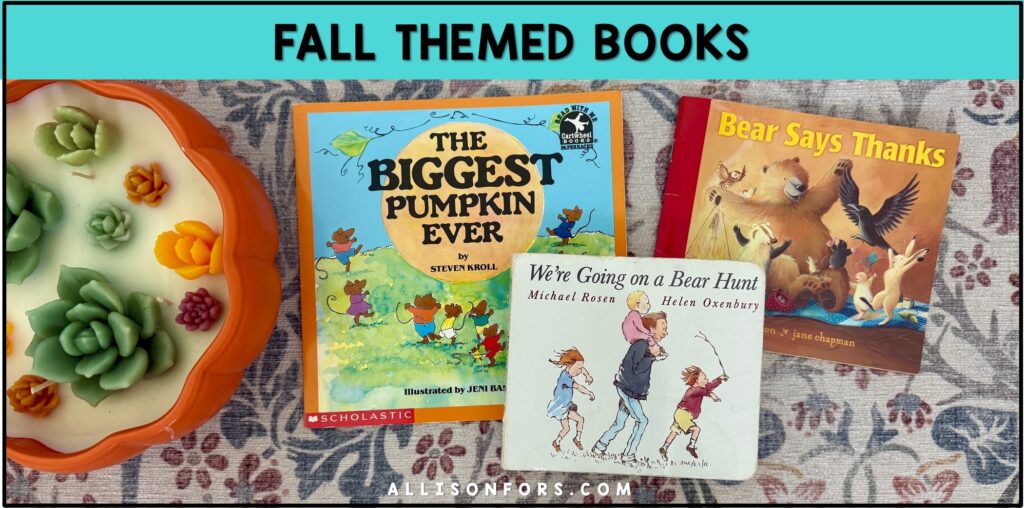
We’re Going on a Bear Hunt by Michael Rosen
A staple in the speech room! It isn’t strictly a fall book, but the outdoor setting, forest environments, and bear make it fit into fall themes. The repetitive, cumulative structure, with built-in onomatopoeia, makes it great for early language students, sequencing, prepositions (over, under, through), and phonological awareness. For articulation, /w/, /b/, /g/, /k/, /ch/, /thr/, and /s/ blends all appear naturally across the text. It also pairs great with “We’re Going on a Leaf Hunt.”
We’re Going on a Leaf Hunt by Steve Metzger
Modeled after the classic “We’re Going on a Bear Hunt”. Each obstacle builds in natural opportunities for prepositions (can’t go under it, have to go over it), and each new leaf introduces a different kind of tree, giving students repeated exposure to nature vocabulary. Adjectives are embedded throughout for describing work, and the rhythmic, repetitive structure makes it excellent for phonological awareness and prosody targets.
Bear Says Thanks by Karma Wilson
The Thanksgiving-adjacent themes of gratitude and sharing make it seasonally relevant. The rhyming, cumulative structure is excellent for sequencing and retell, forest animal and food vocabulary is embedded throughout, and it lends itself naturally for pragmatic language targets. For articulation, /th/ appears consistently in thanks, and /b/, /r/, and velars appear throughout the text.
Fletcher and the Falling Leaves by Julia Rawlinson
Fletcher the fox watches his favorite tree lose its leaves one by one and becomes increasingly worried that something is terribly wrong. This book is ideal for wh-questions at both literal and inferential levels, character analysis, and social-emotional targets around change and uncertainty. It is also great for sequencing and why-questions.
Red Leaf, Yellow Leaf by Lois Ehlert
Part picture book and part early nonfiction. The informational structure makes it a natural crossover for science curriculum and a strong choice for building Tier 2 vocabulary around plant life cycles (nutrients, photosynthesis, roots, sap). For articulation, the /tr/ blend appears frequently and naturally. It also works well for sequencing and retell, and the glossary at the back extends the session if you have time.
The Leaf Thief by Alice Hemming
Squirrel is convinced someone is stealing his leaves. It’s ideal for inferencing, perspective-taking, and using text evidence to support an answer (how do you know Squirrel is wrong?). For articulation, /l/ and /th/ appear throughout in high-frequency positions, making it a particularly useful book for students targeting those sounds.
Goodbye Summer, Hello Autumn by Kenard Pak
The text is spare and lyrical, making it effective for eliciting student-generated language from the illustrations. It’s a strong choice for describing, seasonal vocabulary, and basic concepts, and the compare-contrast structure (what’s different about the forest now versus summer?) gives older students something to engage with.
The Squirrels Who Squabbled by Rachel Bright
A rhyming book. The story is strong for character analysis, compare-contrast, predicting, and perspective-taking, and the theme of teamwork and forgiveness supports pragmatic language targets around problem-solving and friendship. For articulation, /skw/ and /r/ appear frequently throughout.
Too Many Pumpkins by Linda White
The problem-solution arc is clear and funny, and the escalating situation gives students a natural scaffold for predicting, retelling, and cause-and-effect reasoning. Pumpkin and harvest vocabulary are embedded throughout, making it an easy tie-in to any fall unit. For articulation, /p/, /k/, and /g/ appear frequently, and the long, winding sentence structures support grammar targets around complex sentence formulation.
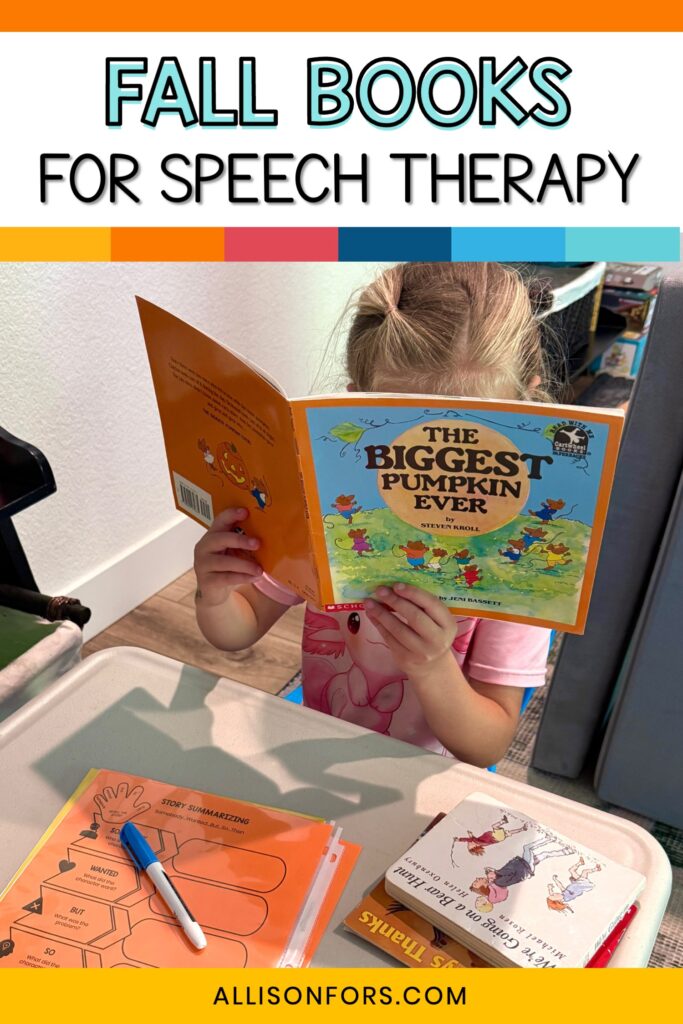
The Biggest Pumpkin Ever by Steven Kroll
Two mice secretly tend the same pumpkin, and both are convinced it’s theirs and both are watching it grow to an enormous size. The dual-perspective structure is the clinical gem here: it sets up natural compare-and-contrast work and is one of the better early-elementary books for perspective-taking and inferencing. The problem-solution arc is clear, the pumpkin and harvest vocabulary is highly functional, and /p/ and /k/ appear frequently for articulation targets.
It’s Pumpkin Day, Mouse! by Laura Numeroff
This one is ideal for early language: emotion vocabulary, describing attributes, basic concepts, and simple wh-questions are all built in. For articulation, /p/, /m/, and /k/ appear consistently throughout. A go-to for preschool and early elementary students, particularly for mixed groups with a wide range of ability levels.
In a Nutshell by Joseph Anthony
The life cycle structure gives it a natural scaffold for sequencing and retelling, and the rich descriptive language throughout. It has lots of great vocabulary! It’s an excellent choice for students working on complex sentence structure and temporal concepts, and higher-level inferencing. It is best suited for second grade and up.
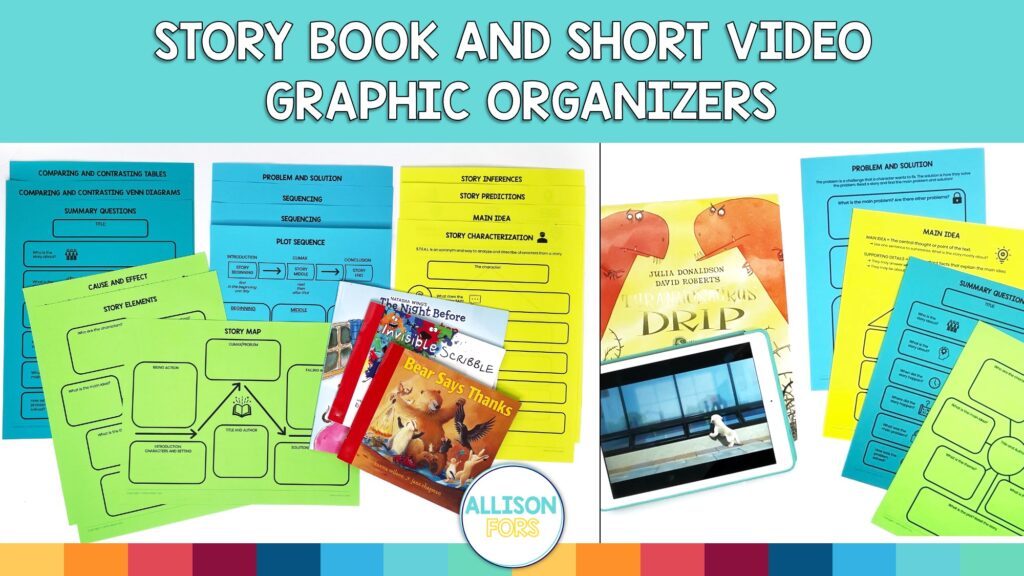
Need story elements graphic organizers to pair with your therapy books? This resource includes character traits, main idea, story retelling, sequencing, comparing and contrasting, and more. These versatile graphic organizer visuals support literacy skills, narrative comprehension, retelling, summarization, and generation.
Thanks for reading!
Do you have any other favorite fall books for speech therapy to add to this list?
You may also enjoy reading these book roundups:
30 Books to Target Inferencing
25 Wordless Picture Books
30 Books to Target Negation

We are a participant in the Amazon Services LLC Associates Program, an affiliate advertising program designed to provide a means for sites to earn advertising fees by advertising and linking to Amazon.com. All opinions are my own.

One Response
I liked these book ideas for making speech therapy more fun and engaging for children. Using stories during sessions can give kids a natural way to practise language and communication. We also use Language Development Support at Rainbows Speech and Hearing Clinic in Mancherial, along with Speech Therapy Services and Child-Friendly Therapy.