
It’s the beginning of the school year, and I thought I would do a “brain dump” of tried-and-true SLP tips and tricks to make work-life for SLPs and SLPAs simpler!
None of these tips require a full overhaul; they’re small adjustments that can make a big impact. We all want to work smarter, not harder!
Try one or two, whether that’s a documentation habit or a template system. The goal is never to do more. It’s to make the work you’re already doing take less out of you.
A lot of the burnout in this job isn’t the therapy itself, it’s the scattered logistics around it. Use digital organization systems to keep track of forms, to-do lists, goal banks, and more that you can pull up anywhere. If you’re drowning in purchased resources, try organizing them in Dropbox by goal or theme instead of by product name, and if your browser tabs are multiplying like rabbits, Google Tab Groups (right-click any tab and add it to a group) will save your sanity.
And my personal favorite that I swear by. Build in a ten-minute closing shift before you leave for the day to set up tomorrow. Make sure your room is picked up; you know your schedule and what is expected the next day. The next morning will go much smoother.
Read more organization tips for your speech therapy materials.

If you’re recreating the same materials over and over, it’s costing you more time than you think. Build reusable templates for everything: emails, session structures, cueing hierarchies, progress note phrases, and IEP language. When you create templates in Google Docs, use headings so sections are easy to navigate, default to the pronoun “they” so you’re not stuck editing for gender, and use a placeholder like FIRSTNAME that you can search and replace with each student’s name. There’s nothing more embarrassing than forgetting to edit that in a report.
For evaluations and screenings you administer repeatedly, slide them into page protectors and mark them up with a thin whiteboard marker, so they’re reusable instead of single-use. A lamination tip: cut your laminated materials before you laminate them, not after; nothing is more frustrating than remaking a set of cards because you cut through the lamination line. I don’t find it makes a big enough difference in how long a material lasts to make up for the added time to cut-laminate-cut.
And if you can find one flexible material that works across most of your sessions, lean into it. You don’t need a Pinterest-worthy new activity every day. My personal go-tos are board games, picture scenes, barrier games, and interactive books. Open-ended resources are the ticket here.
This one is critical: write your SOAP notes while the session is still fresh, not at the end of the week when you’re trying to reconstruct what happened in six different rooms. It genuinely does not get easier the longer you put it off.
My hack is to have one paper per student with their goals listed at the top. I write the data, what we used/worked on, and during the session I jot down what we are going to do next session – if there was a favorite game or activity that worked well, or even just the goal. I print it double-sided. This saves so much brain power for data and lesson planning.
Find my lesson plan form for free.
Also, I love this storage clipboard! I keep all my lesson plan/data papers inside.
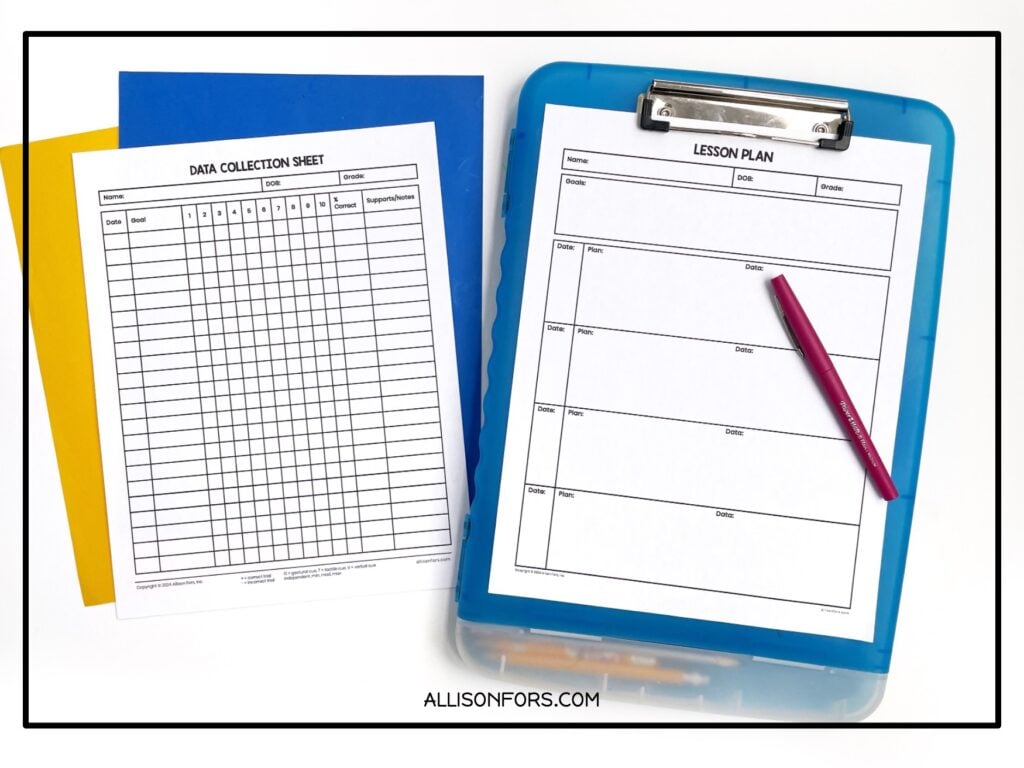
Maybe the most freeing tip in the bunch: you don’t need to take data every single session, and when you do, it doesn’t need to look perfect. Some sessions will produce more qualitative notes than quantitative ones, and that’s a legitimate part of the clinical picture, not a shortcut. Many SLPs concentrate formal data collection in the final three or four weeks before a progress report is due, using earlier sessions to actually teach. That distinction matters: take your time teaching concepts. You don’t have to push a student through all twenty questions in the activity you planned.
Slowing down to check for understanding, re-teach, scaffold, and model will get you further than rushing toward a data point. It also helps to make sure students know their own goals. A quick review at the start of the session and a quick recap at the end gives them a sense of ownership over their own progress, not just something being done to them.
Ask any therapist who’s been in the field a while, and they’ll tell you the soft skills matter as much as the clinical ones. Get to know the front desk, secretaries, and custodians early. Your relationship with them can shape how smoothly your entire year runs. The same goes for your students: don’t rush past rapport-building.
Spending your first few sessions just playing games and talking goes further than jumping straight into drills. And on the harder days, when you need a reminder of why you do this, keep a folder of screenshots, recordings, and notes of the kind things parents and kids have said to you. Open it when you need it.
What other SLP tips do you swear by? Leave a comment below!
You may also be interested in: