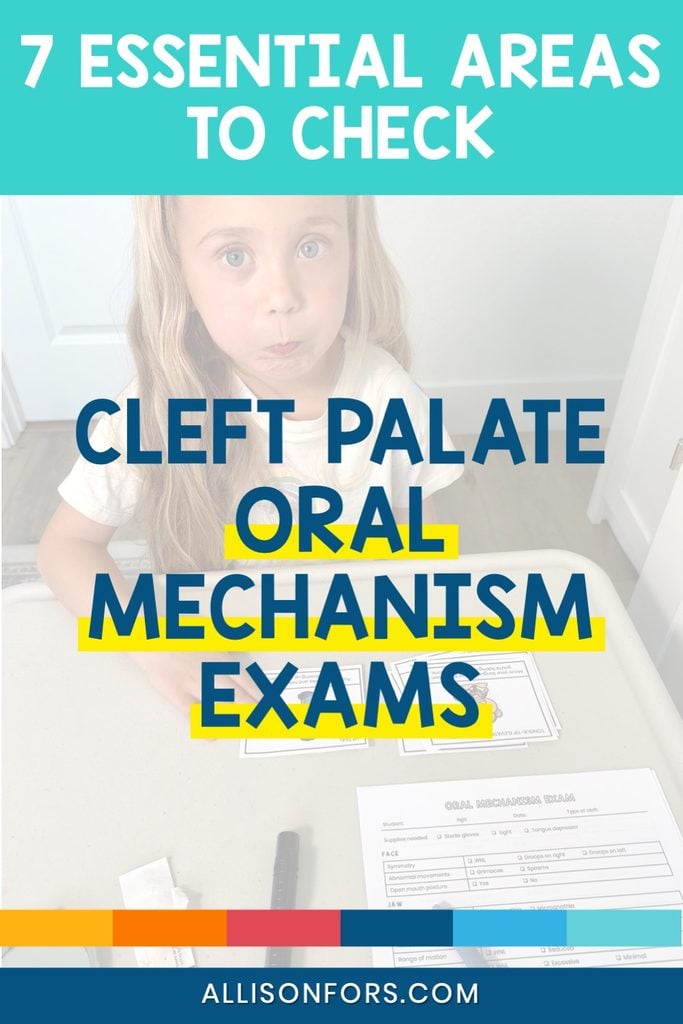
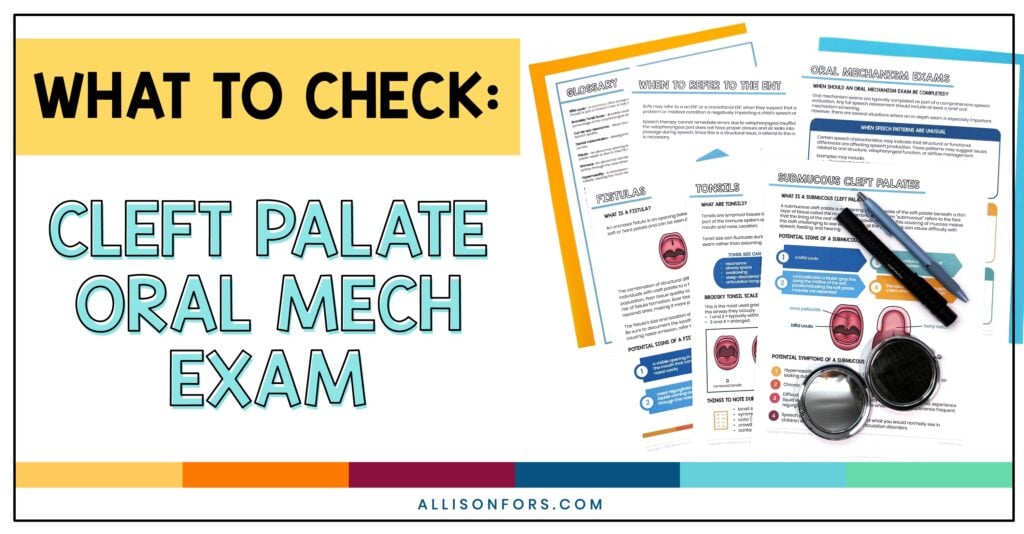
Learn what to look for during an oral mechanism exam for a child with a history of cleft palate, from fistulas and high palates to tonsil size. Here’s what a cleft palate oral mechanism exam should include, and why.
When a palate has been repaired, the structures we’re looking at aren’t just “typical” or “not typical.” They’ve been surgically reconstructed, they’ve healed, and they’re still growing. That changes what we look for, what we document, and what we do with what we find.
This post focuses on the oral mech exam through a cleft lens. If you’d like a refresher on the basics first (what an oral mech exam includes, the tools you need, and tips for getting young kids to cooperate), start with A Practical Guide to Oral Mechanism Exams for SLPs. Then come back here for the cleft-specific details!
Children with cleft palate may have two different types of errors.
Compensatory error: Actively learned maladaptive errors due to abnormal structure, such as glottal stops and pharyngeal fricatives.
Obligatory error: Errors due to structural deficits that require physical management, such as nasal air emission through a fistula.
You may also hear compensatory errors referred to as “active” errors, while obligatory errors are referred to as “passive” errors. This is because compensatory errors are learned, while obligatory errors are a result of abnormal anatomical structures.
Compensatory errors are amenable to speech therapy. Obligatory errors require attention from a craniofacial team. Speech therapy cannot fix errors caused by velopharyngeal dysfunction.
Therapy can correct a compensatory error. It can’t close a fistula. The oral mechanism exam is often where we first get a sense of the anatomical structures, helping us understand which type of error is present.
The mouth of a child with cleft palate keeps changing. Teeth come in and shift. The maxilla grows (or doesn’t grow as much as the lower jaw). Adenoids shrink with age. Orthodontic expansion can open a fistula that wasn’t there before. A child who sounded great at four may not sound the same at nine.
This is why a baseline matters so much. A well-documented exam gives you, the next SLP, and the cleft team something to compare against.
We don’t diagnose velopharyngeal insufficiency (VPI) from an oral mech exam or otherwise. But SLPs are often the professionals who see these kids most often. What we notice and document can be the reason a child gets back in front of the craniofacial team sooner rather than later.
The core of a cleft palate oral mechanism exam stays the same. You’re still looking at structure at rest and function in movement. But pay close attention to the following:
Here are the structural differences that come up most often in children with a history of cleft palate, and why each one matters for speech.
A fistula is an opening that remains (or reopens) between the mouth and the nasal cavity after palate repair. They’re most often found along the line of the repair, especially where the hard palate meets the soft palate, or toward the front of the mouth near the alveolar ridge.
What to look and listen for:
Be sure to document location, approximate size, and whether it seems to affect speech. Not every fistula causes symptoms, and some front-of-mouth openings are intentionally left alone until the alveolar bone graft. My cleft-affected daughter had a fistula after palate repair, although it never presented with any issues with speech or resonance. Not all fistulas are concerning.
Scar tissue and limited growth of the upper jaw can leave a palatal vault that’s high, narrow, or uneven. This changes how much room the tongue has to work with.
You may see this connect to distorted sibilants, lateral or palatal /s/, or tongue placement that’s further back than expected. When an error is driven by the shape of the palate, it’s worth noting. It may affect how you set expectations for therapy and whether you loop in orthodontics.
On a sustained “ah,” look at the soft palate.
Remember, this tells you about movement, not closure. Note what you see and let the cleft team’s imaging (nasendoscopy or videofluoroscopy) answer the closure question.
This one matters most for children without a known cleft history, but it’s still worth checking for in siblings, kids with persistent hypernasality, and kids who were never formally evaluated. Look for a bifid uvula, a bluish-gray line down the middle of the soft palate, a notch at the back of the hard palate, and velar tenting on “ah.” For a full rundown, see Signs and Symptoms of Submucous Cleft Palate.

When the cleft extends through the gum line, there may be a gap in the alveolar ridge (often until the bone graft), as well as missing, extra, or rotated teeth near the cleft site. The lateral incisor is a common one to be missing.
Because the upper jaw may not grow as much as the lower jaw, underbites and crossbites are common. An underbite can make /s/, /z/, /f/, and /v/ tricky because the tongue and lips simply don’t line up the way they would in a typical bite. Some of these distortions are obligatory, and that’s important to recognize before you spend months drilling a sound the structure doesn’t support yet.
During connected speech, watch the face. A nasal grimace (flaring or pinching of the nostrils) is often a sign that a child is trying to control airflow through the nose. Also note facial tension, lip rounding, and any nasal asymmetry.
If a child with a history of cleft palate is hypernasal, look at the tonsils. Very large tonsils can crowd the space at the back of the mouth and throat. In some children, they block the soft palate from lifting fully or the side walls of the throat from moving inward. The result can be incomplete velopharyngeal closure and hypernasality.
Large tonsils can also do the opposite. They can block sound from resonating in the mouth, creating a muffled quality often called cul-de-sac resonance. Some children have a mix of both, which is part of why resonance in this population can be so tricky to describe.
Enlarged tonsils can also push the tongue forward and down, which may affect tongue placement for sounds like /t/, /d/, /s/, and /z/.
Be sure to document:
You can’t see the adenoids during an oral mech, but they matter. In many children with a repaired cleft, the adenoids help the velum make contact with the back of the throat. When the adenoids shrink with age, or are removed, hypernasality can appear or worsen.
This is one reason a child with a cleft history should have the cleft team involved before an adenoidectomy. It’s also why a child who sounded fine in preschool may start to sound hypernasal in the later elementary years. If that happens, it’s worth a referral back to the team.
The oral mechanism exam is a screening tool. It’s powerful, but it has limits, and it helps to name them.
Reach out to the craniofacial team (or ENT, if the child isn’t connected to a team) when you notice:
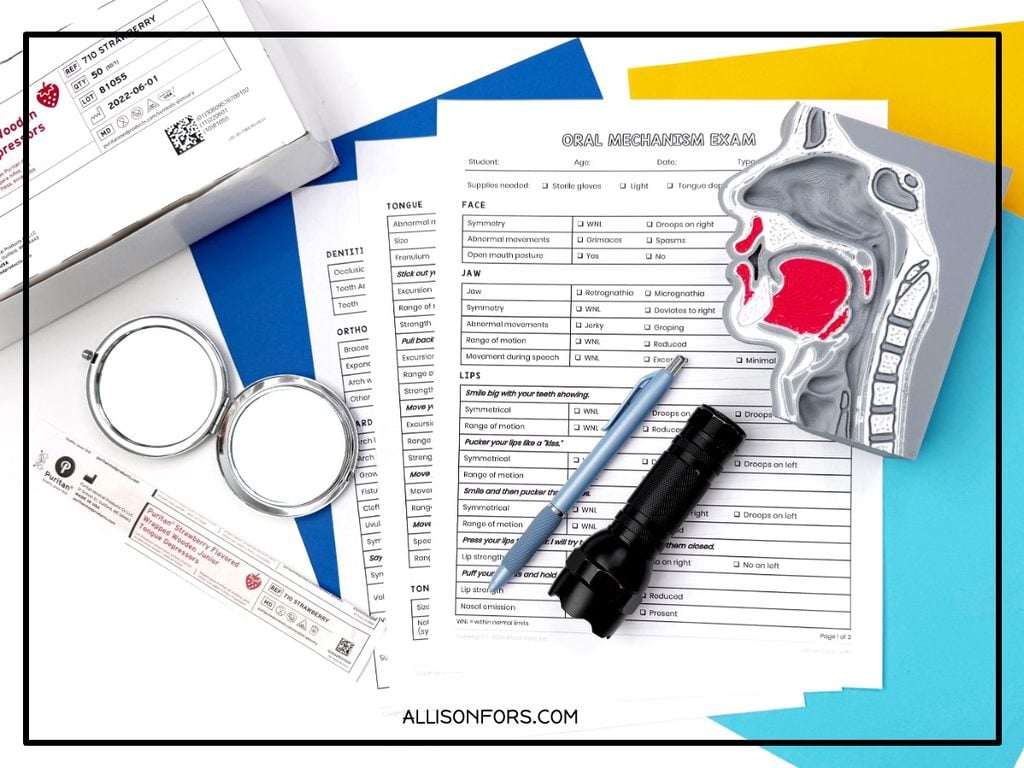
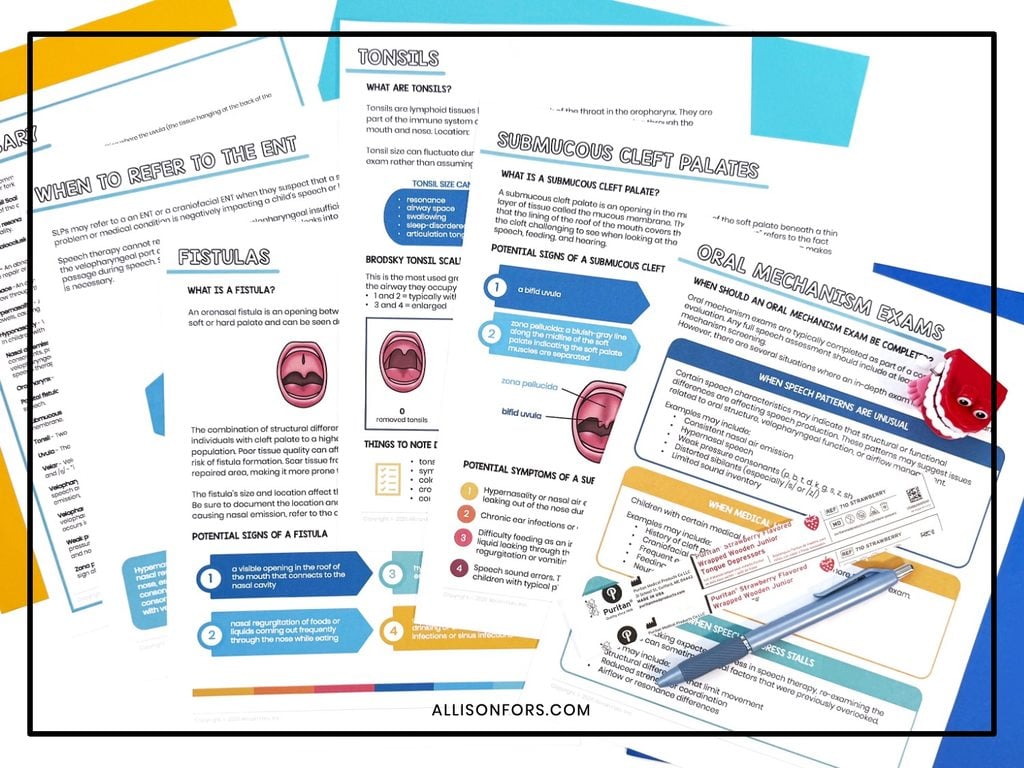
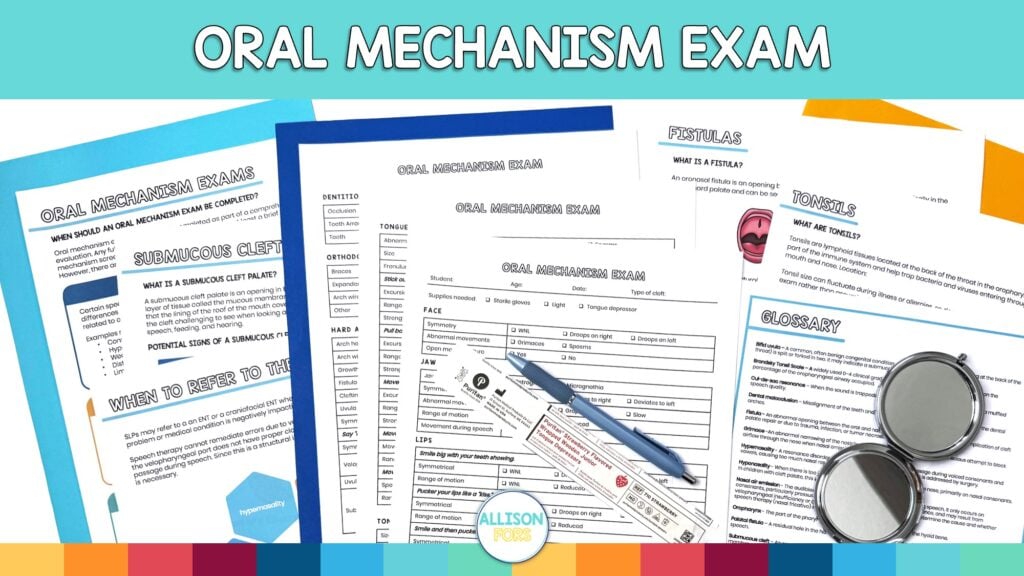
This unique resource walks you through how to complete an oral mechanism examination step-by-step, with an organized exam form, visual picture cue cards, and reference pages explaining common structural differences such as submucous cleft palate, tonsils, and fistulas.
The Cleft Palate Speech Guidebook is a comprehensive manual for evaluating and treating cleft speech. This unique cleft speech book has concise, easy-to-understand information for SLPs and SLPAs to assess cleft speech. In addition, how to treat articulation and compensatory errors. It contains over 100 pages of accessible information to feel confident in treating cleft speech!

You may be interested in reading: