
Want to incorporate summer books to use in speech therapy or the classroom – that are actually worth reaching for?
Books are fantastic, versatile therapy tools. They can address articulation carryover, perspective-taking, inferencing, wh-questions, story grammar, vocabulary, and sequencing. Sometimes all in the same session and across a mixed group. The repeated exposure to language in context, the predictable structure, and the rich illustrations all create the kind of meaningful practice that sticks.
Here is a roundup of summer books for speech therapy, special education, and more. Included are some articulation and language targets you can address with the picture books.
The following summer-themed books are roughly organized from younger to older ages.
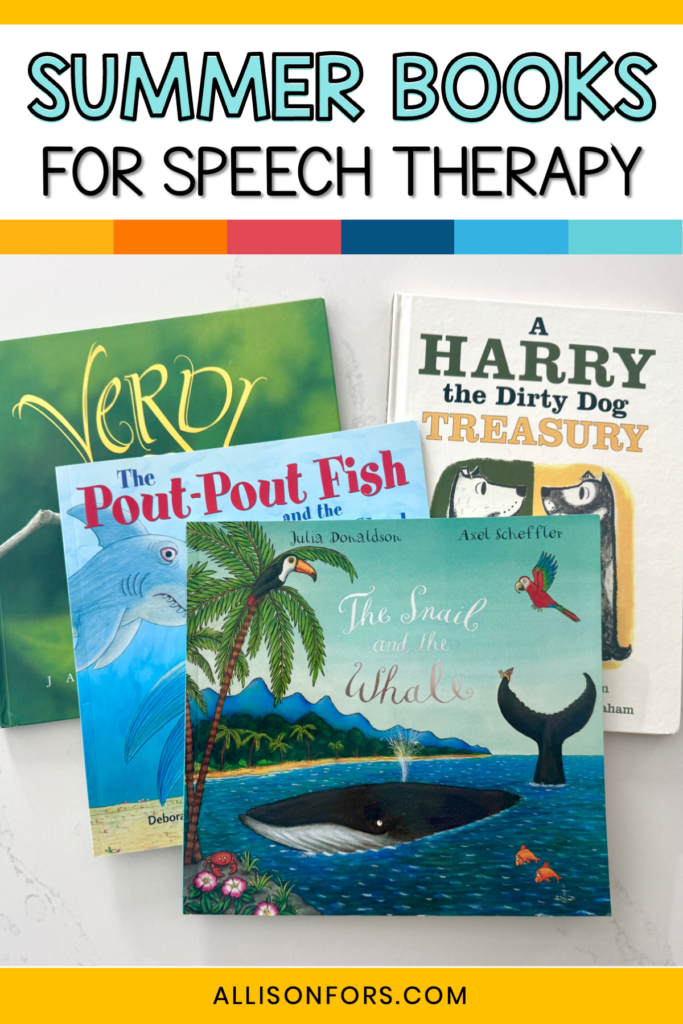
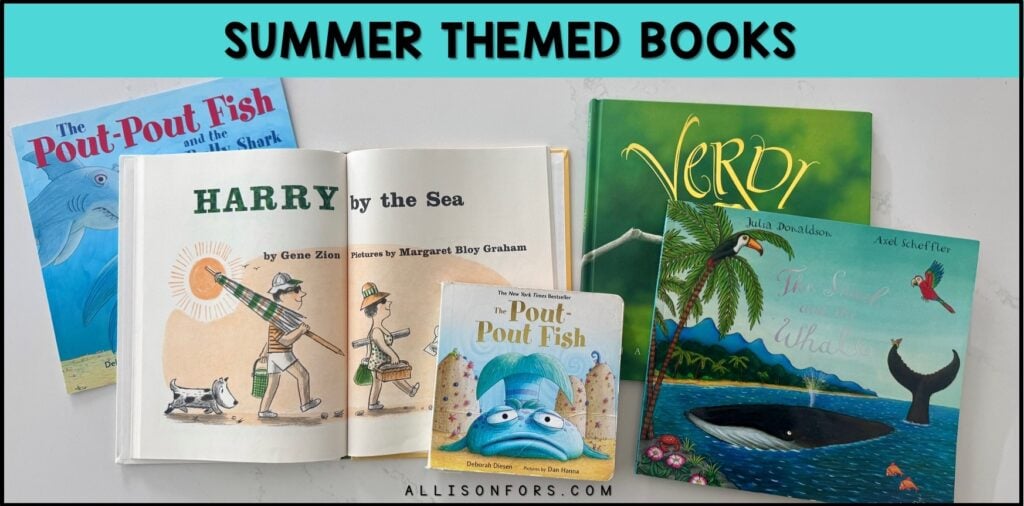
The Pout-Pout Fish by Deborah Diesen
The repetitive, patterned text gives younger students multiple exposures to the same vocabulary and sentence structures, which makes it ideal for building expressive language and expanding utterances. For articulation, /p/, /r/, /l/, /s/, and /th/ all appear consistently across the text. The ocean setting and vivid illustrations hold attention even in the youngest or most distractible groups.
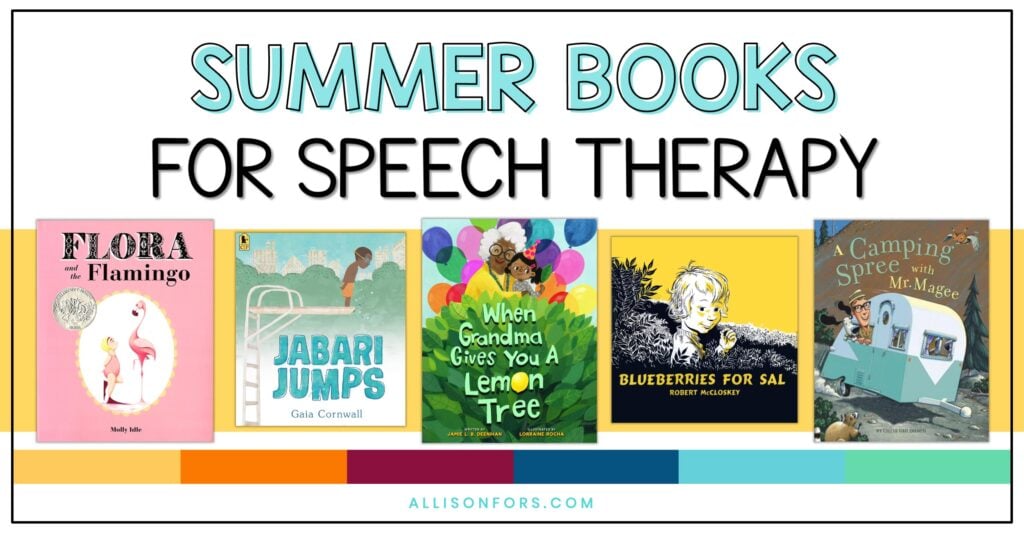
Flora and the Flamingo by Molly Idle
A wordless picture book with interactive lift-the-flap pages that follow a girl and a flamingo learning to dance together. Because there’s no text, the student generates all the language, which makes it a flexible narrative elicitation tool. It is versatile to fit any level: simple labeling and describing for early language clients, full story retell with character emotions and perspective-taking for higher-level students. The /fl/ blend appears naturally in the book’s title and theme, and the interactive flaps add a physical engagement element that benefits attention and turn-taking.
Should I Share My Ice Cream? by Mo Willems
Gerald the elephant has to make a tough decision before his ice cream melts. The short, punchy sentences and expressive illustrations make it highly accessible for early readers and lower-level language clients. It’s ideal for wh-questions at both literal and inferential levels, emotion identification, and pragmatic language targets around decision-making and friendship. The /r/, /f/, and /sh/ sounds appear frequently for articulation carryover.
There Was an Old Lady Who Swallowed a Shell by Lucille Colandro
The Old Lady swallows ocean-themed items and the predictable, repetitive structure provides a built-in scaffold for sequencing, retell, and temporal language. It’s great for predicting what comes next and for reinforcing ocean vocabulary. For articulation, /sh/, fricatives, and velars appear consistently across the text. The surprise ending gives students something to anticipate and discuss.
This story has a clear problem-solution and naturally lends itself to perspective-taking and inferencing. Students who understand what Harry doesn’t are primed to explain, predict, and discuss. The beach setting keeps vocabulary concrete and familiar, and the straightforward narrative structure makes it accessible for early retell work without feeling too simple for mixed groups.
Blueberries for Sal by Robert McCloskey
The parallel narrative structure is one of its greatest clinical assets: it’s ideal for compare-and-contrast, perspective-taking, and predicting what will happen when the two pairs finally meet. The text is loaded with /s/, /l/, /bl/, and /r/ targets across word positions, and the onomatopoeia (kuplink, kuplank, kuplunk) is wonderful for phonological awareness work.
How Do We Get to the Beach? by Brigitte Luciani
A mom tries to get to the beach by bike while keeping track of five items. Every time she gets moving, something gets left behind. The memory and visual scanning demands built into this book make it genuinely fun for attention and working memory targets. Students practice spatial prepositions naturally throughout (on the bike, in the basket, behind her), and the recurring visual of the ladybug on each page adds an I-Spy layer that keeps younger clients hooked.
A Camping Spree with Mr. Magee by Chris Van Dusen
The rhythmic, rhyming text makes it an excellent read-aloud and gives students natural models for prosody and phrasing. It’s strong for sequencing, retell, cause-and-effect reasoning, and predicting. Contains rich vocabulary, and the humor and pacing hold attention in even the most distracted groups.
Down to the Sea with Mr. Magee by Chris Van Dusen
A companion to A Camping Spree with Mr. Magee. The rhyming text is rich in Tier 2 vocabulary (dismay, spectacular, dislodge, downhearted), making it a strong choice for vocabulary building and phonological awareness, alongside core narrative targets such as predicting, inferencing, and character analysis. It also opens up natural opportunities for describing character expressions from the illustrations, which works well for students targeting emotion vocabulary. Pairs great with the camping book if you want to run a Mr. Magee unit.
When Grandma Gives You a Lemon Tree by Jamie L.B. Deenihan
The story delivers a gentle lesson about flexibility and finding unexpected joy, while also loading up on /l/ words throughout (lemon, lemonade, lovely, long), making it a genuine gift for mixed groups with /l/ targets. It also offers opportunities for inferencing, predicting, and higher-level wh-questions.
The Snail and the Whale by Julia Donaldson
The rhyming text has descriptive language and adjective use, making it great for Tier 2 vocabulary and describing. The /sn/ and /w/ blends and final /l/ appear throughout for articulation, and the problem-solution narrative structure is clear and well-scaffolded. This one skews toward older or higher-level students and earns its place in any summer ocean unit.
The tension between what he says and what his body language shows creates a powerful scaffold for inferencing, reading emotions from illustrations, and perspective-taking. It’s one of the more emotionally nuanced picture books on this list, which makes it especially effective for pragmatic language and social-emotional goals with older or higher-level clients.
A favorite for older or higher-level students. Great for vocabulary expansion with words like molt, camouflage, hatchling, reckless appearing naturally throughout. It’s strong for character analysis, inferencing, perspective-taking, and identifying theme. For articulation, /v/, /s/ blends, and /gr/ and /str/ clusters appear frequently. The social-emotional angle (resisting change, finding identity) also makes it a natural fit for pragmatic language work.
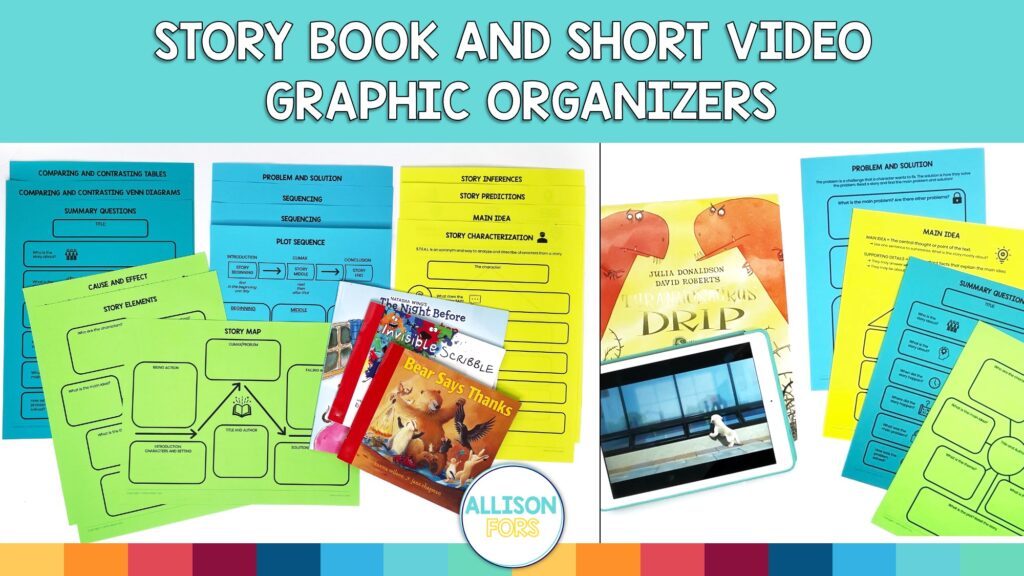
Need story elements graphic organizers to pair with your therapy books? This resource includes character traits, main idea, story retelling, sequencing, comparing and contrasting, and more. These versatile graphic organizer visuals support literacy skills, narrative comprehension, retelling, summarization, and generation.
Thanks for reading!
Do you have any other favorite summer books for speech therapy to add to this list?
You may also enjoy reading these book roundups:
30 Books to Target Inferencing
25 Wordless Picture Books
30 Books to Target Negation

We are a participant in the Amazon Services LLC Associates Program, an affiliate advertising program designed to provide a means for sites to earn advertising fees by advertising and linking to Amazon.com. All opinions are my own.