
Speech intelligibility, which is how well a listener understands a speaker, is one of the most functional outcomes we target in speech therapy. Whether a child has a phonological disorder, childhood apraxia of speech, dysarthria, or hearing loss, intelligibility affects many aspects of life. Boosting speech intelligibility requires looking beyond single sounds and considering the whole speech system, rate, structure, stress, and function.
A lack of speech intelligibility can be due to many factors. These may include limited speech sound accuracy, reduced syllable structure or word shapes, fast or uneven speech rate, atypical stress and prosody, motor planning or coordination difficulties, structural or resonance differences, or hearing loss. Because intelligibility reflects how all of these components work together in real communication, improving clarity requires more than correcting individual sounds.
Speech intelligibility refers to the degree to which a listener can understand spoken output without contextual support. It is influenced by:
Research consistently shows that intelligibility improves when therapy targets functional speech patterns, not isolated sounds alone.
This graphic is the newest research for Hustad, et al. Note: It is intelligiblity levels to UNFAMILIAR LISTENERS.
These numbers are based on unfamiliar listeners in an unknown context. You will notice the dark blue is the milestone (when 95% of children at this intelligible) and the light blue is the average (when 50% of children are this intelligible.)
The snapshot on the left is a summary the researchers gave as a quick way to remember and recite this new information.
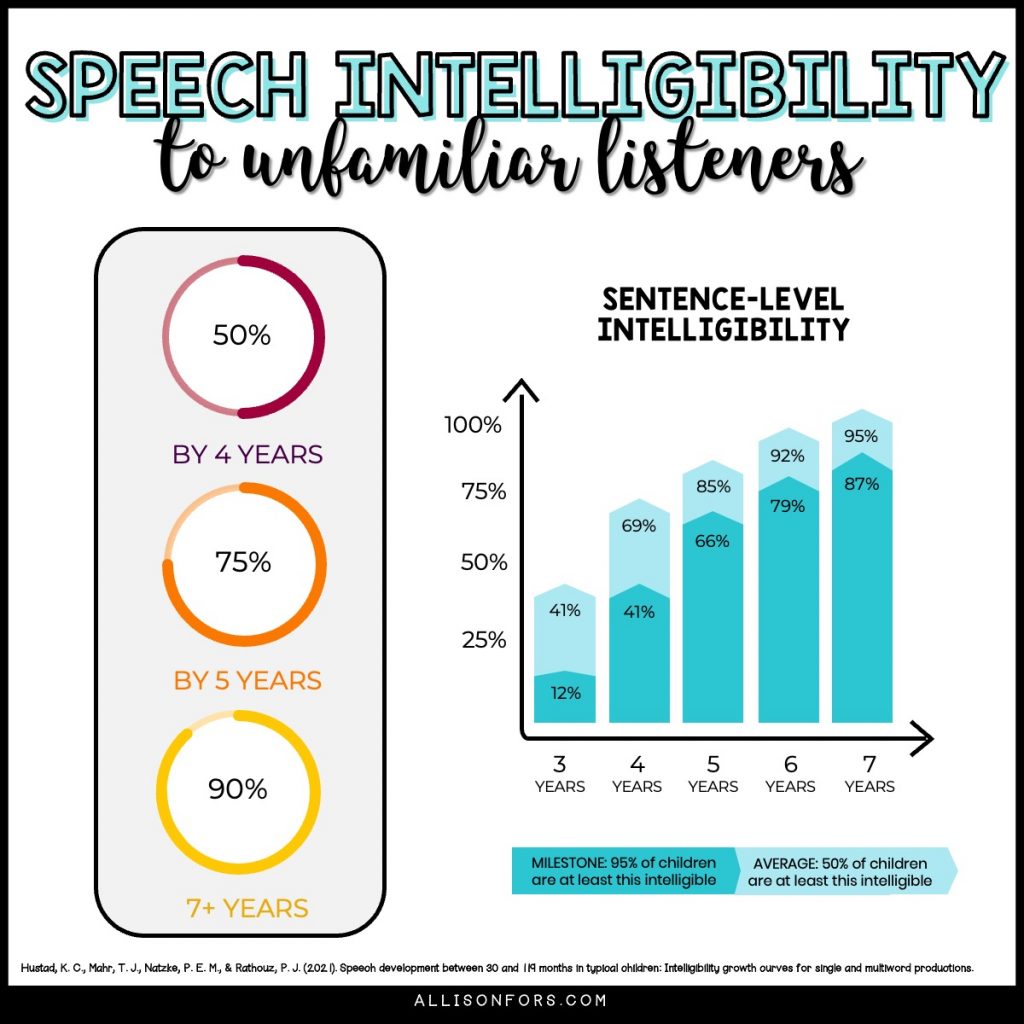
Download this infographic for free.
Below are some gross-overview strategies to improve speech intelligibility.
One of the most impactful mindset shifts is moving from “perfect sounds” to “clear enough to be understood.” Instead of targeting every error, prioritize:
A child does not need perfect /r/ production to be intelligible, but they do need consistent word shapes and salient contrasts. Research supports targeting phonological patterns rather than isolated errors to improve overall intelligibility more efficiently (Gierut, 2001).
Fast speech rate reduces articulatory precision and listener comprehension. Slowing rate often improves: prosodic control, consonant precision, and vowel clarity. However, simply telling a child to “slow down” is rarely effective. For children with motor speech disorders, rate control is a well-established intelligibility strategy.
Instead, use pacing boards or dots, visual finger tapping per syllable, carrier phrases with built-in pauses, or chunking language into short phrases.
Many children with reduced intelligibility struggle more with syllable complexity than with individual sounds. Choose functional, familiar words instead of long word lists. Intelligibility gains generalize better in meaningful contexts! Research shows that improved syllable structure increases intelligibility even when sound errors remain (Stoel-Gammon, 1987).
Target:
Contrast-based approaches (minimal pairs, maximal oppositions) help children understand how sound changes affect meaning. For example, “tea” vs. “key” or “bow” vs. “boat” or “see” vs. “she”. These approaches are particularly effective for children with phonological disorders. Contrast therapy improves listener understanding, not just production accuracy.
Flat, choppy, or misplaced stress can significantly reduce intelligibility, even when sounds are correct. This is especially important for children with CAS or hearing loss. Prosody as a key contributor to intelligibility and listener perception. You want to model exaggerated stress and intonation first, then gradually fade.
You can do this with:
Intelligibility is co-constructed between speaker and listener. Teaching children how to repair breakdowns is just as important as production practice.
Teach skills such as repeating the message, adding one more word, using gestures or pointing, and rephrasing. These strategies align with functional communication and self-advocacy goals, especially for children with persistent speech differences.
Generalization does not happen automatically. Evidence supports embedding speech targets in naturalistic contexts to enhance carryover. Intelligibility improves when practice occurs in play routines, daily transitions, story retell, and peer interactions. Get creative in your sessions and provide natural contexts for intelligibility to occur!

You may also be interested in reading: