
Welcome and thanks to my guest blogger, Elena from Alphabet Trains! Today, she shares tips on communication environments, creating clearly defined activity areas, predictable layouts, and sensory-friendly surfaces to reduce distractions and support longer engagement during speech therapy sessions.
In many cases, when a child struggles with paying attention, our first reaction is to do something about it. We change what we are doing, we add something new and interesting, we go faster, we go slower, and many other things in between. For many children, it is useful to do something like this. However, for many cases of pre-verbal and low attention children, it is not what we are doing, or what we are asking them to do, that is the issue. It’s where we are asking them to do it.
The space provided for a child, such as a bedroom, schoolroom, playroom, or session room, can be a help or a hindrance to the learning that will take place. A space will give a child messages about where to sit, where to look, and what to do. This is especially true for those children who have difficulties with sensory and joint attention. These kids are very aware of the space around them.
For many of these children, if we wish to assist them we have to take a step back and ask ourselves, “Is this space helping my child/student stay engaged?”

Yes, it does. A low-attention learner is working really hard at language processing, filtering out extraneous sensory information, and processing expectations for an activity. If the space is visually overwhelming, or even unpredictable, the child will most likely be working really hard to manage both at the same time.
The thing parents and therapists notice when we simplify our kids’ environments is quite an interesting phenomenon. The type of play that your child is engaging in, regardless of whether it is sensory bins, blocks, and/or sorting, is the same. What differs is the length of time that they are playing, the feeling of settledness that they have in their body and in their brain, and how easily they can focus on the play.
It’s not about clearing up space so that it looks bare and boring. It’s about making it make sense.
One of the most effective ways to support engagement is by defining where an activity happens. For low attention learners, open spaces can feel confusing. If everything is available, nothing stands out. Defined areas create boundaries without words. A small table area might signal work time. A floor space might be for movement or play. Even in the same room, different areas can be used for a specific purpose.
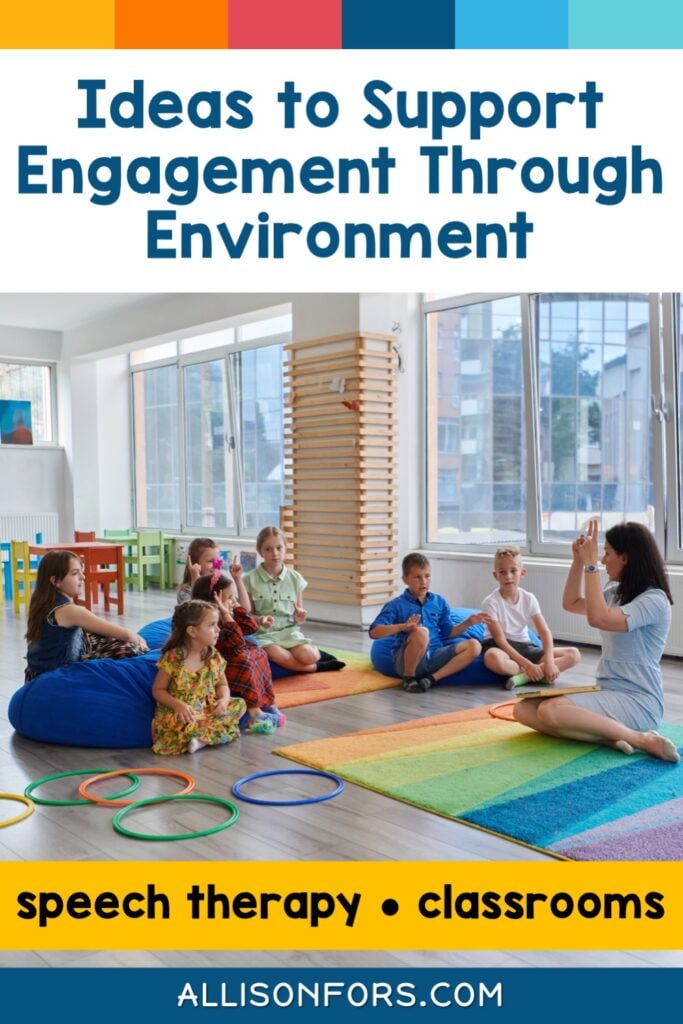
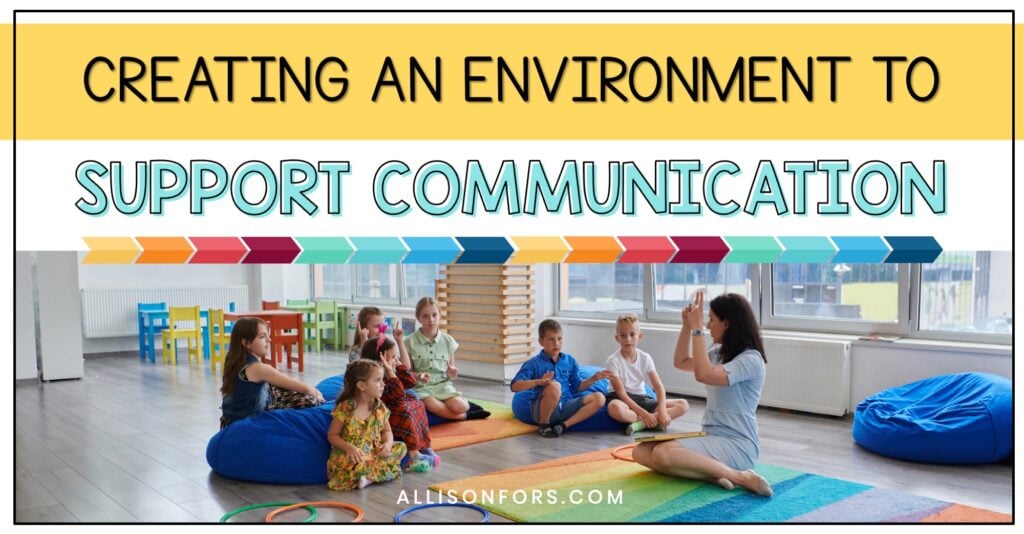
Floor activities are especially helpful for young language learners and children who have a hard time staying in their seats. Educational rugs for example, help distinguish the boundaries of an activity. By finding a specific area on the floor, it can help a little one know where they are supposed to be. It’s not for aesthetic purposes but for its ability to provide a visual boundary that can help with focus. When the floor itself is providing the boundaries, the adult doesn’t have to work as hard prompting the child.
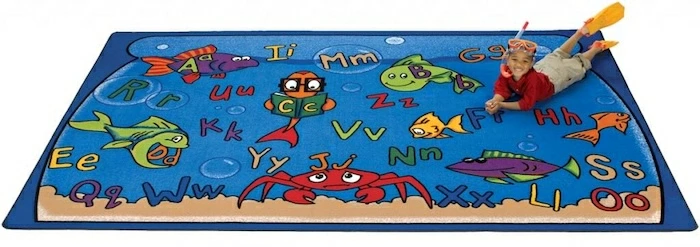
Consistency is key. If the child’s physical space is changing all the time, some of their time learning will be spent just getting their bearings. However, when the space is predictable, the child’s focus and attention can build up over time as the space becomes familiar.
This does not mean the space has to stay the same forever. Change is good and can be built into the environment. But the basic elements of the designated learning spot need to stay the same. For instance, the table should remain in the same location; the designated floor area as well. And materials should be stored in the same location where the child expects to find them.
Furthemore, when the space remains the same, the transition between activities is typically much smoother. Ultimately, when a child knows what to expect from their space, they are more open to interaction and fruitful conversations.
As we know, clutter can be very distracting, this is the same for children. A room full of posters, a shelf full of colorful, random objects competing for a child’s attention can be very distracting, regardless of what he or she may be doing. Of course, this does not mean that they should be in an empty room; it just means that we have to be aware of what we are subjecting them to at a given time.
For instance, we can place the materials on the shelves away from the child’s line of sight, cover unused space on the shelves with fabric, and even control the direction that the child or some objects are facing. It is often surprising what a difference these little things can make.
With fewer objects competing for a child’s attention, a sensory play or a grammar development activity is seen clearer. And a child does not have to work as hard to understand what he or she is doing.
The physical feeling associated with a specific space can also be a contributing factor, similar to the visual aspect. There are some children who are extremely sensitive to texture, temperature, or the feeling of sitting on a specific spot.
Sensory-friendly surfaces can assist a child to feel regulated and prepared to learn or play. A soft surface on the floor, a comfortable seat, or a stable surface can assist a child to feel calm and not restless. There are some children who find sitting on the floor extremely grounding, or for another child, a good supportive chair may be a necessity. The most significant thing is to observe the child’s response to the space and adapt accordingly.
Having a specific floor space with a comfortable surface can also help a child attend to play-based or movement-friendly activities. A child will have a specific spot to settle, but it also allows for different postures to occur.

One of the subtler benefits of this intentional setup is that it can reduce the amount of talking needed to keep interactions going. If the space makes things clear, the adult doesn’t have to direct to what’s expected.
This can be particularly important for pre-verbal children. Too much talking, even if it’s well-intentioned, can be overwhelming. A space that’s easy to read can do some of that work for the adult without the talking.
If the activity space is easy to read, many more children will be able to focus. Over time, this can result in more effective interactions. The adult can spend more time paying attention to communication attempts, rather than constantly managing the space.
Setting up an environment doesn’t mean you have to change the whole room. Sometimes, making small changes can have a big impact. One thing you can do is sit in on a play session and see where the potential breakdown is happening. This is where we can observe and think: “Is the child distracted by the shelves behind him or her? Are the transitions confusing? Is the space too open?”
If you are a parent working from home, these concepts can be applied. Having a small dedicated workspace can help a child understand when it is time to learn, play, and rest. In addition, having boundaries and routines is incredibly beneficial for helping a child engage without forcing them to do so.
Sometimes, looking at how others have managed these in a physical space can be helpful. There are many examples of how defined floor spaces and visual boundaries are used, especially in therapy and learning situations. A circle time setting is a good example. Having a defined space to gather seems to help children calm and settle more easily and be more available to interact. Rugs can be used in creative ways to transform learning spaces; they can be very helpful in making simple changes that are easy to implement.

When working with children who have difficulty maintaining focus, it is rarely about finding the “right” activity. More often, it comes back to the space around them. When a room or designated space they’re in is carefully arranged, it begins to work for us. There is less effort put toward determining where to sit and what to focus on, and more energy is left for maintaining focus. Wherever that space may be, when it truly meets a child’s needs, interaction often follows with far less resistance.
Thank you, Elena, for sharing such helpful tips on creating an ideal learning communication environment!
Written by Elena Maren Montessori guide and early childhood writer at Alphabet Trains.
Are you interested in being a guest blogger? Fill out this form!