

In articulation therapy, “high trials” refers to a large number of practice repetitions, ideally 50-100, during a therapy session. The 100 trials are the “golden number” for encouraging meaningful phoneme acquisition and motor pattern development. This approach is essential for helping individuals with speech sound disorders to establish and generalize new motor patterns for accurate sound production.
Why high trials matter:
There are various activities I like to use to achieve high repetition trials, such as 100 charts, spinner games, sticker charts, or using manipulatives.
I especially love using games that have a large number of pieces or turns, as they provide a structured and motivating format to reach these high numbers efficiently. Each child gets multiple turns, with each turn involving several actions.
The key: Ideally, the child has 5–10 repetitions of the articulation word per turn.
I’ve compiled a list of favorite games that reliably support this high-trial approach and quick pace. When properly adapted, these games make it fun and practical to meet high trials during speech therapy sessions!
A simple game for kids to carefully pull leaves from the tree while hoping not to spill the bees. The goal is to have the fewest bees in your tray at the end of the game. Before pulling a leaf, the child gets 5-10 repetitions of their target sound!
A classic counting game for younger children, where kids pick various fruit from their “tree” and place them in baskets. The first player to collect all their fruit wins. The repeated turns make it easy to get articulation practice and trials during play.
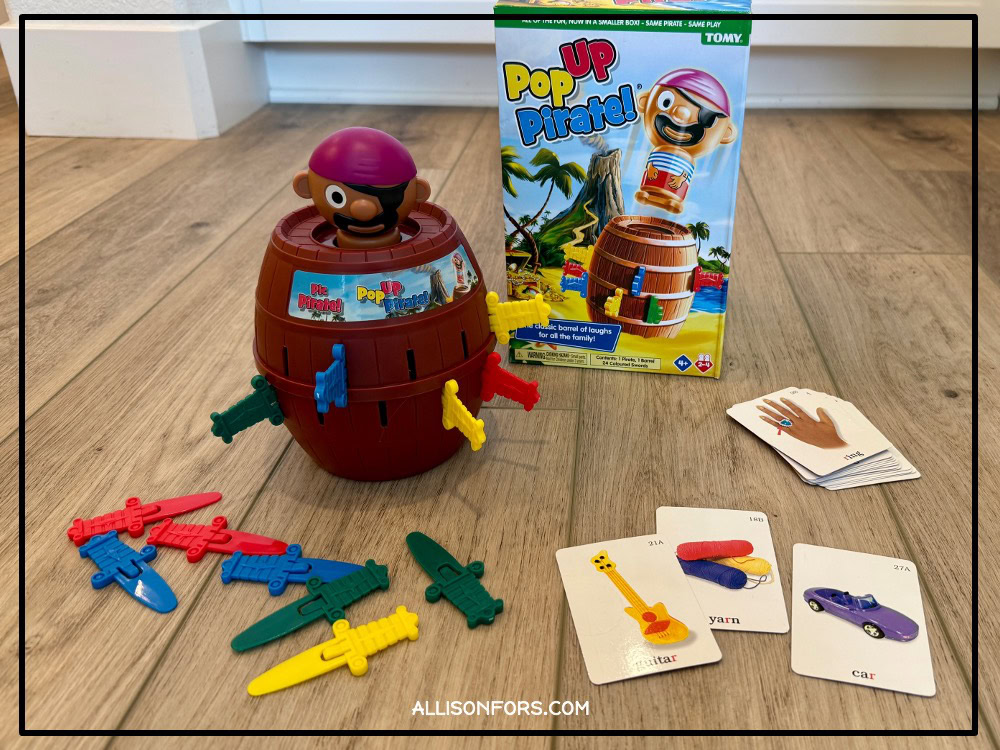
This is a fast-paced game that naturally encourages repeated word use as children announce colors, swords, and take turns (“Blue sword,” “My turn,” “He popped!”). Kids take turns sliding swords into a barrel until the pirate pops out. The quick back-and-forth dialogue creates numerous spontaneous speech trials without requiring additional rules.
A fun game for younger children, players take turns rolling the die and fishing for colorful sea creatures from the shark’s mouth using a rod. At any moment, the shark can snap shut, and the player with the most creatures collected wins. This is an excellent game for high-trial articulation, requiring no extra rules.
They take turns trying to sneak treats from a bear’s basket, and while there is potential for the bear to awake at any moment. Again this game has quick turns and is very engaging for children!
Players pull the bananas from the treetops until the monkey jumps. Practice 5-10 articulation words before each turn! The game Jumping Jack is a similar game concept with a rabbit and carrots.
Another fun “jumping” or “pop up” type game. Roll the dice, select the color acorn, and feed Charlie the squirrel. This game is perfect for conducting numerous articulation trials with its fast turns back and forth.
A simplistic game with great opportunities for back-and-forth turns. Players take turns removing wooden blocks from the tower and stacking them on top without tipping it over. This game can easily be used to target specific words or sounds. Before a block is pulled or placed, the child says their target words or phrases 5-10 times. I’ve known SLPs who write the words on the blocks!
Players drop colored checkers into a vertical grid, aiming to get four in a row before their opponent. The repetitive nature of dropping multiple pieces makes it easy to reach high word productions per game, and you can easily supplement with additional vocabulary.
Battleship is a great game for older children with a bit of strategy to keep them engaged as they practice. They take turns calling out grid coordinates like “C‑7” or “H‑2” to try to sink opponent ships.
Do you have any fun games you use in articulation therapy? Comment below!
You might be interested in reading:

If you enjoyed this post, please share it!
We are a participant in the Amazon Services LLC Associates Program, an affiliate advertising program designed to provide a means for sites to earn advertising fees by advertising and linking to Amazon.com. All opinions are my own.