
Want to learn more about velopharyngeal insufficiency? Have a student demonstrating hypernasality and/or nasal emission, and you’re not sure what the next steps are? This guide will answer your questions so you’re confident in understanding VPI and the SLP’s role.
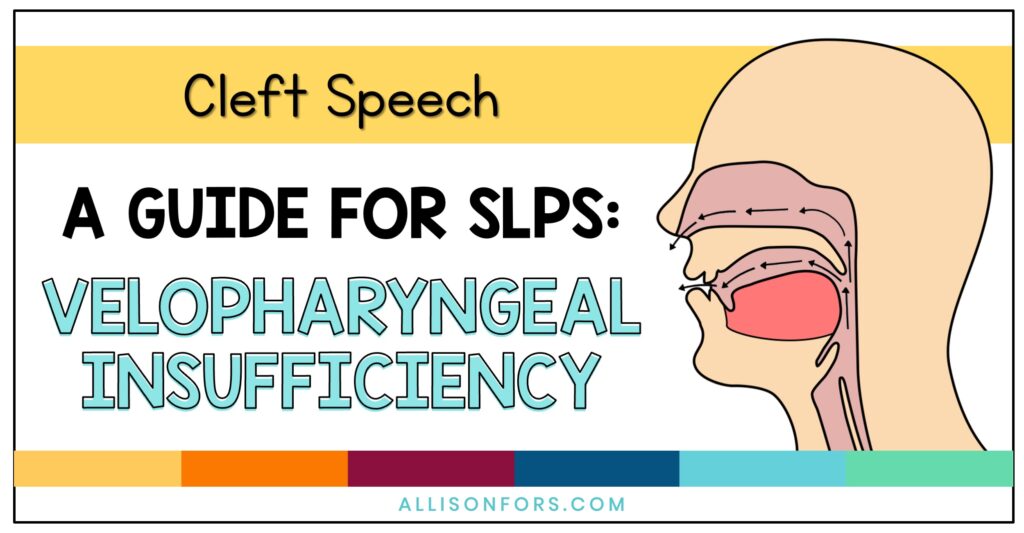
Velopharyngeal insufficiency (VPI) is a term to describe an anatomical or structural disorder that prevents adequate velopharyngeal closure. This is characterized by the inability of the soft palate to form a proper seal against the back of the throat during speech, leading to nasal air escape. The velopharyngeal port, formed by the soft palate (velum) and the lateral and posterior pharyngeal walls, plays a critical role in separating the oral and nasal cavities. When this closure is incomplete, air and sound escape through the nose during speech.
It is the most common type of velopharyngeal dysfunction (VPD) because it involves a short or abnormal velum, which occurs in children with a history of cleft palate or submucous cleft palate.
For speech-language pathologists, VPI most often presents as a resonance and airflow disorder rather than a true articulation disorder. VPI characteristics can significantly impact speech intelligibility, even when articulation placement is otherwise accurate.
Note: If nasal air escape occurs on only one or two sounds, it reflects phoneme-specific nasal emission and can be targeted in therapy, as it does not indicate a structural issue.

Approximately 20% of children with a repaired cleft palate have persistent VPI. (Hayakawa T, Thao TP, Niimi T, et al., 2025)
In cases of true VPI, speech therapy cannot correct the underlying structural deficit. This distinction is critical for SLPs and SLPAs, as inappropriate articulation therapy may delay referral for instrumental assessment or surgical management. The SLP’s role is to identify red flags, provide accurate differential diagnosis, and collaborate closely with interdisciplinary cleft and craniofacial teams.
Understanding what VPI is and what it is not lays the foundation for appropriate assessment, referral, and intervention planning throughout the rest of the treatment process.
Note: Speech therapy CANNOT FIX hypernasility, hyponasality, or nasal air emission from velopharyngeal insufficiency. Speech therapy is only effective when teaching the placement of abnormal speech sounds caused by velopharyngeal dysfunction.
Speech therapists are often the first professionals to suspect velopharyngeal insufficiency based on perceptual speech characteristics. Listening across connected speech, structured tasks, and pressure-loaded contexts is critical for identifying red flags that warrant further assessment and referral to a craniofacial team.
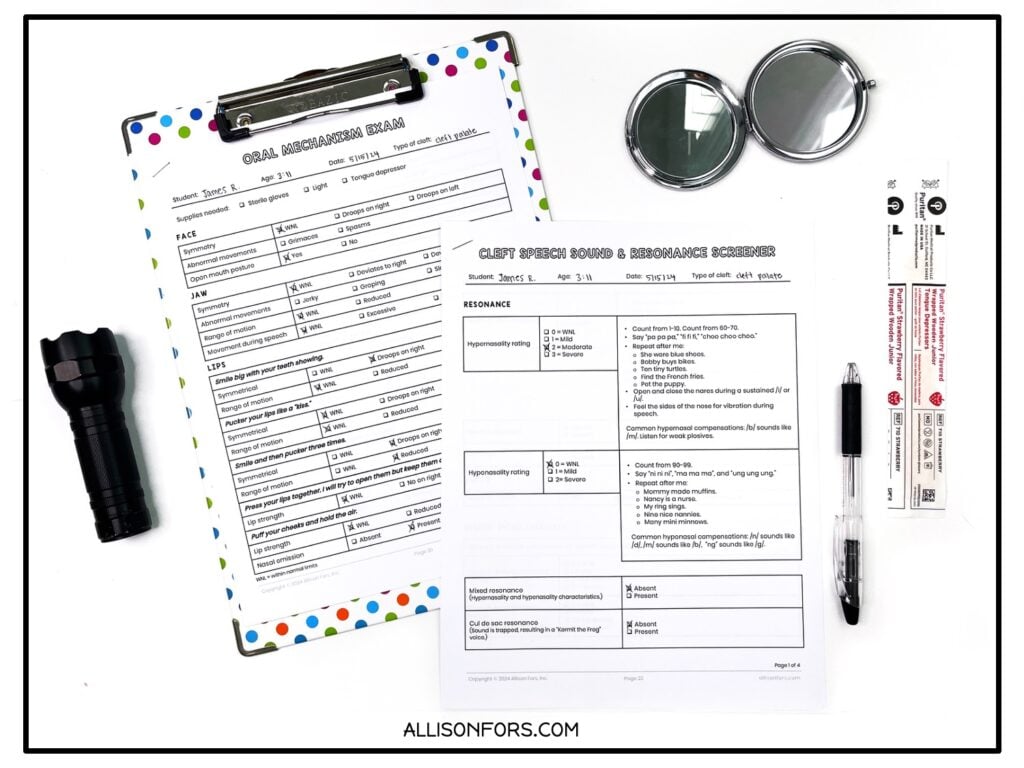
Be sure to complete a thorough oral mechanism exam and an informal assessment to determine whether speech therapy can address the errors or if you need to send a referral to a craniofacial team.
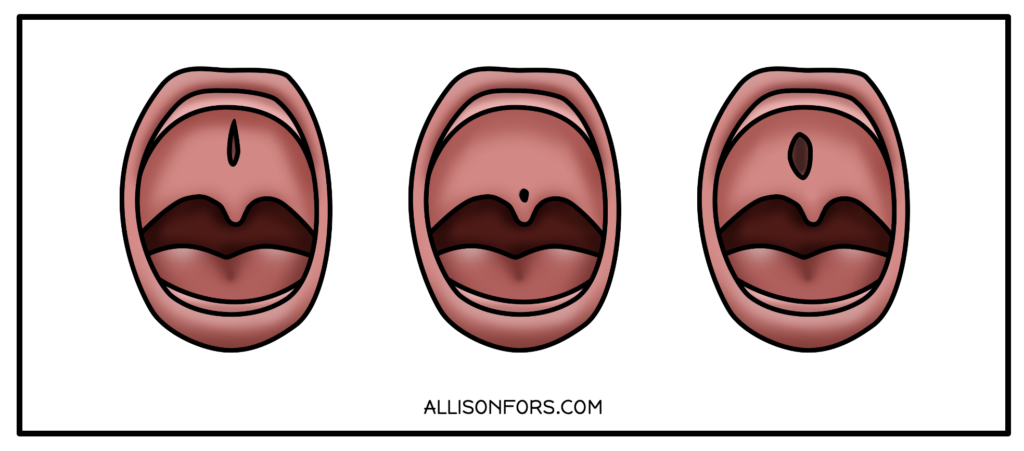
During an oral mechanism exam, you will need to look for anything that may compromise speech production, such as a fistula, a submucous cleft, or enlarged tonsils. During an informal assessment, use phonemically loaded sentences to determine the affected sounds.
Assessment Tools:
Hypernasality is the most common perceptual feature associated with VPI. It is characterized by excessive nasal resonance during the production of vowels and voiced oral consonants (e.g., /b, d, g, z/). Typically, hypernasality is more noticeable on high vowels and in connected speech than in single-word productions. If vowels sound nasalized even when articulation placement is correct, consider a resonance-based disorder rather than an articulation error.
Nasal air emission occurs when air escapes through the nasal cavity during the production of oral pressure consonants, particularly voiceless sounds such as /p, t, k, s, f, ch/. This may be audible (presenting as a nasal rustle or snorting sound) or inaudible (detected through physical signs such as nasal grimacing or by using a mirror or straw under the nostrils).
Nasal air emission reduces intraoral air pressure, often making consonants sound weak, imprecise, or omitted.
Children with VPI may demonstrate reduced loudness or imprecision on pressure-loaded sounds due to inadequate oral air pressure. Stops, fricatives, and affricates may sound “soft,” shortened, or distorted, even when placement appears appropriate. If a child understands where to place the articulators but cannot generate sufficient pressure, a structural cause should be suspected.
Over time, children with untreated VPI may develop compensatory articulation patterns to bypass the velopharyngeal valve. Compensatory errors are learned errors, while VPI errors come from structural differences. Compensatory errors are treated through speech therapy, while VPI is NOT treated by speech therapy and oftentimes requires surgery.
Common examples of compensatory errors include:
These learned patterns can coexist with VPI and often persist even after surgical management, requiring targeted speech therapy post-operatively. Approximately 25% of children with cleft palate use compensatory articulation errors, and glottal stops are the most common error. This post has more information on compensatory errors.
Speech may sound relatively clearer in low-pressure contexts (e.g., vowels, nasals, short utterances) but significantly deteriorate during longer utterances, increased speech rate, or pressure-heavy tasks. This inconsistency is an important perceptual cue that the velopharyngeal mechanism is not consistently achieving closure.
A major red flag for VPI is a lack of progress despite appropriate articulation therapy. For example, the child may have correct placement, but resonance and pressure errors persist.
If you suspect VPI, refer the child to a craniofacial team for evaluation by a craniofacial SLP and surgeon, who will determine the appropriate treatment plan. Children with a history of cleft palate typically already receive care through a craniofacial team. For children without cleft involvement, refer to a craniofacial ENT or specialized craniofacial team rather than a general ENT.
The diagnostic process is comprehensive, involving a combination of clinical assessments, instrumental evaluations, and collaboration with other healthcare professionals.
Note: School-based SLPs and private practice SLPs do not diagnose VPI because it cannot be confirmed or ruled out solely on perceptual assessment.
Here is an overview of the steps typically taken by a craniofacial SLP and craniofacial team to diagnose VPI:
When instrumental assessment confirms velopharyngeal insufficiency, the craniofacial team determines the most appropriate course of management. Recommendations may include surgical intervention (such as a Furlow palatoplasty, pharyngeal flap, or sphincter pharyngoplasty), prosthetic management in select cases, or continued monitoring if findings are mild or inconsistent. These decisions are based on the child’s anatomy, velopharyngeal closure pattern, speech characteristics, and overall medical profile, and are directed by the craniofacial surgeon in close collaboration with the craniofacial SLP.
Once VPI is confirmed, traditional articulation therapy aimed at “reducing nasality” or “building oral pressure” is not appropriate before medical management. During this period, therapy, if recommended, typically focuses on:
School-based SLPs play a key role in adjusting therapy goals and avoiding ineffective or inappropriate intervention while the child awaits treatment. In some cases, the craniofacial team may recommend pausing direct speech therapy altogether until surgical or prosthetic management has been completed.urs.
My cleft-affected daughter was diagnosed with velopharyngeal insufficiency at five years of age and subsequently underwent a Furlow palatoplasty. At the time of diagnosis, she demonstrated nasal air emission across multiple pressure consonants, including /s/, /b/, and /t/. These symptoms became increasingly noticeable as she grew older. She also presented with nasal rustle and mild hypernasality.
Her evaluation included nasometric assessment completed by her craniofacial SLP, followed by nasoendoscopy performed by her craniofacial ENT to assess the size and location of the velopharyngeal gap. These findings guided the surgical planning and selection of the appropriate repair.
During the diagnostic and surgical planning process, we paused private speech therapy services, while she continued to receive support from her school-based SLP.
A reliable diagnosis of velopharyngeal insufficiency is typically made when a child is older, most often between 4 and 6 years of age. At this stage, the child can consistently produce oral pressure consonants and tolerate instrumental assessment such as nasoendoscopy.
In younger children (e.g., around age 3), a limited sound inventory, active phonological processes, and learned compensatory patterns may mask or mimic VPI, making accurate diagnosis more challenging.
Yes. While cleft palate is a common cause, VPI can also result from other structural factors. These may include mechanical interference (such as enlarged tonsils or posterior pharyngeal wall webbing), a deep or atypically shaped pharynx, or trauma affecting the velopharyngeal mechanism.
Yes, there is another term, velopharyngeal incompetence (VPI), to describe a neurophysiological disorder that causes reduced or poorly timed movement of the velopharyngeal structures. Conditions such as dysarthria and childhood apraxia of speech fall under this category, and speech therapy is appropriate when neuromotor impairment drives the speech characteristics.
VPD is a generic, umbrella term for resonance disorders. It includes:
VPD occurs when the velopharyngeal port is not properly closed during speech or swallowing. Air leaks into the nasal passage during speech production due to inadequate speed or range of function of the soft palate. This can result in nasal air emission, hypernasality, abnormal speech, and decreased intelligibility.
An oronasal fistula creates an opening between the oral and nasal cavities and is visible during an oral examination. When a fistula causes nasal air emission, surgical intervention is necessary. Refer the child to a craniofacial team to determine whether surgery is indicated.
The Cleft Palate Speech Guidebook is a comprehensive manual for evaluating and treating cleft speech. This unique cleft speech book has concise, easy-to-understand information for SLPs and SLPAs to assess cleft speech. In addition, how to treat articulation and compensatory errors. It contains over 100 pages of accessible information to feel confident in treating cleft speech!